Friday, 10 July 2009

Translations from the edge, codecs at the centre: Methodist Conference 2009

methodist conference wolverhampton civic hall  2009Now that I am back home from the Methodist Conference I am mulling over the significance of the many hours of debate, decision making, conferring, conversation and worship which took place.

How is the world a better place today because of all that was said and decided in Wolverhampton? What difference will it make here in Lincolnshire, or anywhere else for that matter? How will it be understood -  if it is noticed at all -  by British society? What meaning will it have for poor and disadvantaged communities here and on the other side of the world?

How has it changed me? What happens next?

These are some of the questions which I now have to answer as I seek with others to translate the experience of Wolverhampton into strategic vision and practical action across the Lincoln and Grimsby District. And translation is the right word to use for this vital task.

As you can see there was ongoing real-time language translation provided for our world church guests. Sitting in the Conference Hall each of the Districts is processing the business in real-time too. We put the stream of information through our own contextual filters and get ready to contribute if needs be. This is especially important when views from the edge which speak of being marginalised, hurt, inspired or encouraged need to be voiced and heard. methodist conference interpreter for world church representativesNaturally enough in all of this we  translate the proceedings into the familiar faith-speak and language which works in our context but crucially we are challenged with new vocabulary and fresh idioms from elsewhere too.  The variety of 'faith-dialects' and nuances from across the globe as well as across the UK is one of the joys of our being together. So many postcards from the edge gathered in one place for us to appreciate.

For all of us in Conference, wherever we are from, there is one unifying task going on under the surface.  The question mark on the screens in the Conference Hall could usefully have been there all week to provoke the thought: what does this mean to me/us and for me/us?

methodist conference wolverhampton 2009Note - not just 'to', as that points to a response which could be far too narrowly cerebral and liable to become inconsequential, but 'to and for', as that implies purposeful thinking turning into attitudes, actions, imperatives and real consequences. And because such a process of translation is hugely contextual the end result here in Lincolnshire could look markedly different to that in South London or Cardiff. It need not, but it might.

Perhaps this is the genius of being a connexional church. The collective, connected us has an amazingly diverse and fantastically rich identity. That which is expressed locally in a myriad of Methodist faith dialects reflects our rich common language.methodist conference wolverhampton 2009 vote being taken This is why Conference cannot fail to be inspiring.

And because we are Methodists what happened at Conference will make a difference locally and globally; that is how we are and this is what we do. When we vote on issues that matter to us the whole Connexion is represented.

On climate change and racism we have taken landmark decisions this week which will affect the whole church.

Ekklesia picked up the story about the BNP like this:

"The Methodist Church has become the first major denomination in the UK to ban all its members from joining the British National Party (BNP). A resolution passed by the annual Methodist Conference, meeting  in Wolverhampton, declared that “No member of the Church can also be a member of a political party whose constitution, aims or objectives promote racism. This specifically includes, but is not solely limited to, the British National Party”. The news follows a similar ban on Church of England clergy, but the Methodists have gone much further, saying that no-one can even be a member of the Church while also belonging to the BNP. “We must be clear that racism is a denial of the Gospel” said Rev Sylvester Deigh, who proposed the motion. “An openness to all people, regardless of nationality, is at the heart of Methodist identity” he continued. The motion was seconded by the Rev Dr Angela Shier-Jones. While strongly condemning racism and the BNP specifically, the motion declares that “those who support racist parties are also God’s children, and in need of love, hope and redemption”. Supporters of the measure are keen to emphasise that no-one will be banned from attending a church – only from membership of it."

conference crossCrucially we hope that we express our identity in ways which the world will take notice of and understand. So far today I have yet to see this vote making headlines in the media.  Through Google I did find this response, though, posted by a  BNP member on an internet forum:  "Following on from the C of E's banning of priests being BNP members, the rapidly declining Methodists have now gone one step further in banning BNP members from even being part of the church. Even emptier pews for the Accrington Stanley of the UK's religious league."

Now I would expect a pejorative  reply, so no surprise there. Culturally, however, I am fascinated by the picture of Methodism which this man espouses, because I have a hunch that what we see here would in fact be a very widely-held view in British society.

For the record Accrington Stanley finished mid way in the Coca Cola League two table for the 2008/2009 season, three places below Lincoln City and well above Grimsby Town. We are not talking top-flight Premiership here. So in terms of numbers this guy is wrong. But what of "rapidly declining" and "empty pews", these are things which we have said about and to ourselves!  As key descriptors of our church is it any wonder that such things can be said about us when for too long we have engaged in such a narrative of despair? More worrying still is the implication that our pews already contain significant numbers of BNP members. I don't believe this to be the case at all, but even if there were a grain of truth in what he says it shows just how timely was the notice of motion on racism which we agreed yesterday.

The laptop on which I am writing these words needs specific bits of software  - codecs - in order for it to play music and video in a wide range of formats. A missing or corrupted codec is a right pain and can be really annoying. Society at large needs up to date cultural codecs if what we say and do is not to be seen and heard as gibberish, irrelevant or, at worst, as being simply unplayable. out of darkness cometh light wolverhampton art gallery stained glassIf this is to happen we have to tell a fresh story and, more importantly, live the transforming story of the gospel at the heart of our local communities in ways which are meaningful, engaged and relevant to local needs and contexts. The resolution we passed on racism and the BNP demonstrates clearly what we stand for, who we are and what we are prepared to do. A church which is committed to improving social capital and to working with others to transform society because it is wholly and enthusiastically open to God, the gospel and to all sections of society is a resurgent church. This is who we are becoming.  Right across the age spectrum. We have to do all that we can to get this new codec embedded at the centre of society, and the best way is surely to live out the gospel of grace at its sharp and painful edges. The nails which comprise the conference cross convey this truth powerfully without words. Every person on the edge is at the centre of our concern. The BNP member has a wonky codec and half a story. Through our new story we hope that he might yet find that transforming grace for himself which leads to life in its fullness. In this context the motto of the city council in Wolverhampton is highly appropriate, and is depicted in this stained glass window on display in the city art gallery. Out of darkness cometh light.

Wednesday, 8 July 2009

the pouncing gargoyle

winchcombe pouncing gargoyleI originally used some of these images at our Ministerial Synod earlier in the year, and then again shortly afterwards when I was asked to lead devotions at our Chairs of District meeting. For some time I have been meaning to work them up and post them, so at long last here they are.

winchcombe grinning demonThese magnificent gargoyles (or more accurately 'grotesques') are a selection of those to be found on St. Peter's Parish Church in Winchcombe.  They are extraordinary examples of a surprisingly common ecclesiastical artform.  Here the masons have carved a health warning in stone, for the grotesques are refreshingly candid and show with commendable honesty what someone can expect to experience should they enter the church and engage in the life of faith with this particular group of people . The grotesques demonstrate the reality of those warped and contorted behaviours and attitudes which wait to strike the community of faith. It is why we have procedures to deal with complaints and discipline. The pouncing gargoyle, the cat-like creature in the top image poised to leap down on the unwary passer-by, is particularly striking and fits well the text from 1 Peter. Whatever one's views on the language and symbolism used, the psychological reality to which it points is real and familiar. Medieval faith appears to be up front and honest about the broken and vulnerable nature of our selfhood to a degree which we find strange today. Perhaps our comparative reticence does not serve us well. Anyone looking up at the Winchcombe grotesques would hardly be likely to expect the congregants to be perfect. Today the charge of hypocrisy is easily levelled at church folk because the common view is that we are supposed to be a cut above your average secular 'sinner'. Winchcombe gives the lie to this misperception and offers a common bond of neediness to those inside and out the church.

winchcombe demon

Take this image for example: in this striking representation the king of demons is having what seems to be a well self-satisfied laugh at our expense. Trying to live a good life is clearly no easy matter. The carving is a public admission of this uncomfortable truism, and a warning to be on one's guard. Might it then also be an invitation to enter and find release, the medieval equivalent of a neon-sign?

The ancient service of compline is redolent of this need for vigilance and preparedness in the face of temptation, wickedness and evil. It acknowledges a primary reality of being human which besets us still. And because it is honest about how we are, not least towards each other, this church is a beacon of hope. The grotesques very visibly project a powerful message out into the community: if this is what you wish to be released from, come inside. It is only when we recognise the grotesque-ness in our own thinking and behaving that we can seek to transform it and find release from its power.  It is as though the carvings say: bring it on, do your worst, for here you will find a power greater than your torment. Again the service of Compline offers this sense of realism and hopefulness. Surely the healing power of God's love in Jesus can set us free from the psycho-social 'demons'  of our time too?winchcombe winged demon

winchcombe gargoyle

So although the carvings and the liturgy of Compline seem to belong to another seemingly unrecognisable world, they do in fact point to something ever so contemporary. Violence, corruption, abuse, addiction and exploitation could very easily be some of the names for those things which the masons sought to represent by their grotesques. The power of such to pounce and inflict hurt and harm in our time is very real. Perhaps we have much to learn from this honesty of stone and liturgy. And by so doing we might just have much to offer to our communities too.

Tuesday, 7 July 2009

discipleship means...

see tell and call

The window looks out onto the world around. From this high vantage point much can be seen. The window is also ajar, so the sounds from outside enter freely and can be heard readily. The weather vane can do nothing other than tell it as it is and point out the direction of the prevailing wind, which is of course invisible. The bell waits to call people to action. 

For me this is a picture of discipleship.

And in this shot it is the bell tower and weather vane which are exceptional and which first caught my attention, for this part of the building is truly out of the ordinary.

As disciples of Jesus we  are called to see the world as he sees it. So we try to look at everything and everyone from a godly viewpoint. This is a tough call because seeing appreciatively, generously and compassionately, with great grace, is not our natural human default position. Our evolutionary psycho-social development means that quite the reverse is often the case.  To practice lovingly understanding, empathetic and inclusive vision is too see each other with eyes full of delighted hope, from a heart full of grace.

Then we can truly listen deeply to what the other is saying, and saying not just with words but with the whole of their life. To listen in this way is to be alert for those cadences of need and insight which hint at and sometimes reveal where Jesus is standing in the life of this person, group or people.

So far to so good. And then we come to the exceptional bell tower and its weather vane. Having seen and listened, our discipleship comes alive when we move on to do naturally what  Jesus did, which is to tell and call. And I guess it is at this point that we move into the territory of matters which are more out of the ordinary. Having seen and listened to the pain and distress in the world around him, Jesus told it as it was and pointed to the eternal loving purposes and ceaseless activity of God at work in the world. Faced with needy and suffering people Jesus responded. And he responded with the gospel of God's love which meets us face to face. He responded with that activist, subversive politics of passion which he called the kingdom of God. Jesus embodied, enfleshed and made real the hidden reality at the heart of creation; the love in whom we live and move and have our being. Such love is constantly striving to make all things new. His disciples are called to do likewise; to see and listen deeply and to respond by making the presence of God's love really apparent and relevant, as we strive to make all things new in and through our passionate kingdom lifestyles.

And then Jesus called those he met to make a personal, heart-felt response to this face to face love of God for them and others. Jesus calls us to respond and become agents of change, to be transformed and transforming, and to follow him into the suffering and hurting places within the world and in ourselves. We are to know and to be the gospel right there. Through such prophetic love the call to that which is hopeful and holy is manifest. Telling and calling are surely central and essential to such a ministry of encouragement and social justice.

Seeing, listening, telling and calling are at the heart of our vocation as followers of Jesus. When we see, listen, tell and call as he did, we really are acting as his disciples in the world.

Saturday, 4 July 2009

global emissions: downslope to eco-disaster

global emissions dowslope to eco-disaster

"It is now intellectually and morally irresponsible to fail to acknowledge and address the urgent need for radical cuts in greenhouse gas emissions in order to prevent intolerable damage to human populations and mass extinctions of many plant and animal species."

Hope in God's Future: approaching God in the context of climate change

The Methodist Conference in Wolverhampton has an historic opportunity to use 'Hope in God's Future' as a springboard to initiate radical action right across our church. Climate change and the urgent need to reduce global emissions is one of the truly great mission challenges of our era. Lack of political will, economic incentives and meaningful global agreements to curb greenhouse gas emissions mean that we are already heading downslope to eco-disaster. So the question is not how can we avoid it, as the time for that is past; instead we now have to ask how can we minimise its effects.

And it is the poor in the developing nations of the world who will be hit earliest and hardest by the climate-driven consequences of the rich world's laissez faire attitudes and practices.

The time for rhetoric is over, because the time for dying has already arrived for our most vulnerable sisters and brothers worldwide. Jesus stands tearfully in their midst and looks at us in utter bewilderment, just as he wept over Jerusalem and the failings of its policy-makers and decision-takers at the end of his own life.

As he came near and saw the city, he wept over it, saying, ‘If you, even you, had only recognized on this day the things that make for peace! But now they are hidden from your eyes.

Luke 19:41-42

Friday, 3 July 2009

With wonderful tenderness God already loves us behind the locked door to our inner self

hidden secrets and shameful memories behing a locked door

and waits there to embrace us. Right there in the very place which is so enduringly troublesome for us to enter. Right there in the damaged soul-space in which it so difficult for us to love ourselves. It is there, right there where we feel most unloveable, that God desires to cherish us into life.

An image for use in worship and personal reflection

And a  wonderful poem written by Liz Smith, which gets to the heart of pastoral ministry and the gift of truly safe space which it can provide. Perhaps it is just such a bounded and protected space which is at the heart of 'the cure of souls'.

When the door slams shut
and I turn the key
on the inside;
when I permit no window of hope,
no glimmer of grace,
nor comfort of companionship;
then, in your tenderness,
You gift me with one
whose kindness turns the key,
whose courage cracks
the combined codes of pain
and fearfulness;
one who eases the door ajar
to welcome first shafts of sunlight
and promise of freedom.

Thursday, 2 July 2009

enlightenment in an Indian restaurant

light fitting

You're here to be light, bringing out the God-colours in the world. God is not a secret to be kept. We're going public with this, as public as a city on a hill. If I make you light-bearers, you don't think I'm going to hide you under a bucket, do you? I'm putting you on a light stand. Now that I've put you there on a hilltop, on a light stand—shine! Keep open house; be generous with your lives. By opening up to others, you'll prompt people to open up with God

Matthew 5:14-16

Sitting in an Indian restaurant having a meal with friends my imagination was caught by these elaborate light fittings. Rather than having a shade the light was  shining off a brightly coloured background and shining through the translucent petals of a flower pattern fitment. It seemed to be a visual analogy of how we radiate the love of God in Jesus Christ. The utter simplicity of the imperative to "love one another as I have loved you" is personalised and individualised within and through each one of us. Although each human 'light stand' is unique the spectrum of God's inclusive and liberating love is consistent. The shapes and patterns of our being should not detract from nor blot out the light of divine love, but rather they should complement and draw attention to its marvellous propensity to enlighten and illuminate us.

As the images make clear, the light brings out the very best in that through which it shines so brightly. It changes our perception of something which might otherwise be perceived as being dull and unattractive. What we see are "God-colours" and an illuminating testimony to a radiant beauty which would otherwise be hidden. The challenge is to open up to others about the light of the world at work in our lives in such a way that they might then in turn be open to the possibility of what life might look like when the light shines through them too. 

light fitting 2

Tuesday, 30 June 2009

the ever present danger is that we will destroy that which we do not value

bryn cader faner snowdonia

Regular readers of this blog will know that I have  an affection for ancient monuments, especially those from the earliest periods of our prehistory in Britain. I find the sense of sacred mystery which enfolds such sites really attractive: a good dose of the unfathomable and impenetrable is good for my soul I guess, especially when it is combined with beauty, artistry and a palpable sense of human achievement and expression. These places are precious for they are part of the story of who and how we are; they are waymarks on the spiritual and cultural journey which has led to here, now and today.

It is all the more vexing then when one discovers that such a site has been vandalised - perhaps the word should be desecrated - at some time in the past. One such example is depicted here: the Bryn Cader Faner bronze age ring-cairn in  North Wales. Treasure seekers in the nineteenth century and soldiers in the twentieth have all taken their toll on the monument. Clearly each group had another purpose in mind which took precedence over the cairn circle, regardless of its antiquity or archaeological value. Bernie Madoff took a similar approach to the wellbeing of the investors he ripped off and ruined. Short term personal gain so often proves more powerful than long term collective good. Which is why we are frying the planet with human-induced climate change.

bryn cader faner bronze age ring cairn snowdonia

The Christian Faith takes a diametrically opposed view to this selfish outlook. We speak and act out of a conviction which prizes interdependence, mutuality and the long view. We seek to uphold the intrinsic value of everything from people to landscapes and complex ecosystems. They all have inherent worth, and should be treated and regarded respectfully and carefully. When everything is seen as sacred one treads gently on one's path through life. Loving-kindness and justice are expressions of this way of looking at and being in the world. 

The ever present danger is that we will destroy that which we do not value. The present state of Bryn Cader Faner is a simple and stark warning from history concerning our cavalier attitudes to the planet and the people which are our home. Before a stone was displaced and the cairn disturbed there was a real need for the contrary view to be put and upheld.

In today's world that is our ethical task. And the stakes have never been higher.

bryn cader faner bronze age ring cairn snowdonia close up

Monday, 29 June 2009

Fortifying faith without limit

40mph limit railway speed restriction sign

An image for use in worship and personal reflection

You can play with the sense and meaning of this sentence in any number of ways. Naturally the irony is intentional. Some see faith as being fortified by limits, restrictions and exclusions. Others maintain that faith can only be strengthened when love is unlimited. Where do you stand?

Sunday, 28 June 2009

the shape of divine love in the life of Jesus always casts light on the challenges of today

the shape of divine love in the life of Jesus always casts light on the challenges of today

An image for use in worship and personal reflection

(click on the image for a larger version)

Friday, 26 June 2009

disempowering patriarchy

disempowering patriarchy constantine york minster

Here is a cover waiting for a book if anyone is minded to write it.

As you see it is both a statement of fact - patriarchy is disempowering - and a vision for one way in which the  church might be remade in God's image - disempowering patriarchy.

I offer the image as my response to the funeral of my Aunt, which was yesterday.

The service took place in an Anglican parish church which does not welcome the priesthood of women and which is under what I believe is called 'alternative episcopal oversight'.

The priest who conducted the service was well meaning and very sincere.

As a Methodist presbyter, however, I found myself in a foreign land and could not separate the specific act of celebrating the life of a remarkable and much-loved woman from the surrounding context of an ideology of gender exclusion.

How can 'power patriarchy' be anything other than a blight upon both church and gospel? How can silencing women and excluding them from key roles in leadership be 'according to the mind of Christ'? Get a life.

The gospel I read tells me that Jesus empowered the powerless and included the excluded.

The picture of the statue of Emperor Constantine outside York Minster is not a criticism but a whopping question mark concerning power in the church, any church.

Does God weep or rejoice that women are excluded in this way?

I don't hear divine blokey-bloke laughter at this iniquity. And tears fall silently. But the hurt is real.

Wednesday, 24 June 2009

well-worn steps of faith

well worn stone stairway


Well-worn steps of faith

the soul-making way to God

and true-self.

Fresh expressions

emerging church

alternative worship

the latest cachet enhancing

unchurched attracting

ideas and inspirations

all lead here

eventually

don't they?

The footsteps of Jesus.

The dark night of the soul.

So many feet

so much hope

such great love.

Each step a 'yes': the pathway of assent into God.

___________________________________________________________________________________________________

Sally has written a great  poem to go with this image. See Danny's helpful post too.

Sunday, 21 June 2009

shape without substance and form without power

shape but no substance

Bourton-on-the-Water

It has the recognisable shape of a first generation Mini, but.....it's a classic case of shape without substance and form without power. It resembles one thing but is actually something quite different.

'Shape without substance' may well have been on John Wesley's mind when he penned his  "Thoughts Upon Methodism":

"I am not afraid that the people called Methodists should ever cease to exist either in Europe or America. But I am afraid, lest they should only exist as a dead sect, having the form of religion without the power. And this undoubtedly will be the case, unless they hold fast both the doctrine, spirit, and discipline with which they first set out."

In our Methodist understanding then,

To try and do church without being totally open to the lovingly creative power of the Holy Spirit would be a bit like trying to drive this garden planter: don't be surprised if you get nowhere fast. Yet still we reach for the keys.....

And to try and do church without an active commitment to social justice and the poor would be to have the form of religion without the power too (read Blake Huggins post for more on this)

Shape without substance and form without power is both a warning from our collective past and an encouragement for our collective future: in all things we can ask the question of ourselves, what shape and form should the church adopt in order to express the revolutionary transformative substance of the gospel and the powerful liberating presence of God's grace?

Saturday, 20 June 2009

Christianity: a lens and a window onto other worlds

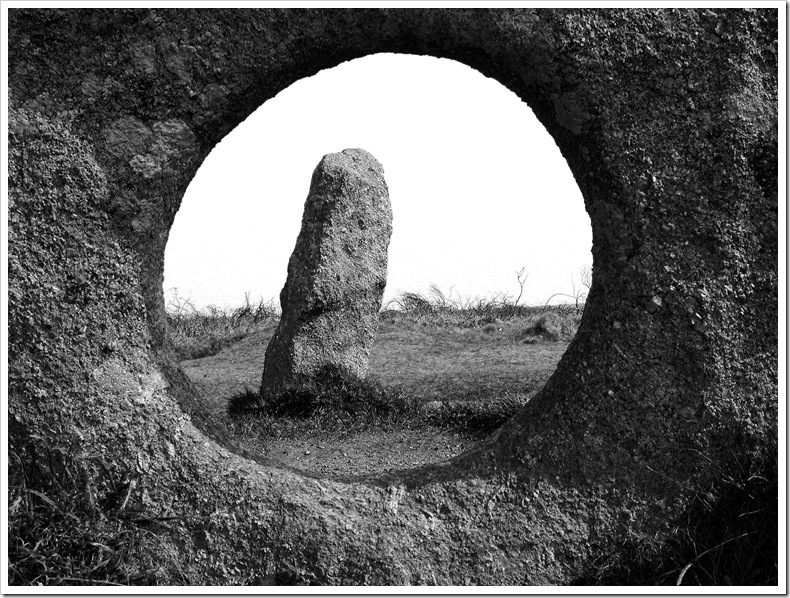
Men-an-Tol  (lit. holed stone) is an enigmatic megalithic structure in the far west of Cornwall. Sadly for us its original meaning and significance are forever lost and irrecoverable in the dead silence of the oral traditions of our prehistory, as is the case with the Rollright Stones and Northumbrian prehistoric rock art. A2M, the online guide to Cornwall's archaeological heritage, says this about Men-an-Tol:

a recent site survey identified a number of recumbent stones lying just beneath the modern turf which were arranged along the circumference of a circle 18 metres in diameter. ...If this is indeed the origin of the site, the holed stone would probably have been aligned along the circumference of the circle and would have had a special ritual significance possibly by providing a lens through which to view other sites or features in the landscape, or as a window onto other worlds.

It is that last provocative sentence which triggered my train of thought in this post. Christianity is a religion in which the original meaning and significance of the life and death of Jesus is known and recovered through the passionate praxis of contemporary disciples every bit as much as it is through the scriptures, doctrines, traditions and theology of their predecessors in the faith. Looking at Mel-an-Tol today we are left in the dark about its ritual and sacred value in the culture of its time, as the flow of praxis was broken and the story lost. Not so with Christianity. We have 2000 years of richly diverse spirituality to inform our understanding; two milennia of theological reflection, discipleship and ecclesiology to consider. The line is unbroken and the story is still strong.

The world may sometimes look with puzzlement at what we do and the things we say, a bit like modern tourists looking at the stones of Mel-an-Tol and thinking "what is this all about, what does it mean, why is it here?", but we are here, and here to stay. The down to earth realities and truth of our faith are as strong and vibrant and pertinent now as they were when Jesus broke bread with his friends. Jesus was a  lens and a window onto other worlds: the roman imperial world of political violence and socio-economic oppression, the Jewish religious world of power and exclusion, the ancient world of sickness and death, the cruel world of hunger and poverty, and most of all the living world of God's presence and love for all.

The challenge to the church of today is to avoid becoming an enigmatic monument disconnected to the story, experiences and needs of contemporary humanity.  To remain in touch and connected it is imperative that we continue to offer what humanity seems to value highly, that lens and a window onto other worlds of meaning and significance. Surely it is vital that we continue to offer and live out alternative ways of seeing each other and the world in which we live; framing for ourselves and others the world as Jesus sees it. One thing is certain, looking through the lens and window of Christianity there are many worlds to be seen: the world of gross economic inequality and social exclusion, the world of racial hatred and ethnic violence, the world of mental illness, the world of gender injustice, the world of loneliness and despair, the world of climate change and environmental degradation, the world of exploitation and trafficking, the world of HIV/Aids, the world of war and terrorism. And there are so many more besides.

Not least the worlds that Jesus saw so very clearly: the world of political violence and socio-economic oppression, the religious world of power and exclusion, the world of sickness and death, the world of hunger and poverty, and most of all the living world of God's presence and love for all.

We look at these worlds through the lens and window of Jesus Christ, whose God-story is always and forever our story too.

Wednesday, 17 June 2009

The squeeze

the squeeze on side pike 2lingmoor fell and side pike mapHaving read about 'the squeeze' in a fellwalking guide to the Lake District, I just had to see it for myself. You have to pass this way to get from Side Pike onto Lingmoor Fell if you want to avoid having to backtrack almost to the road. The precipitous sides of the crag offer no other direct alternative to the path you see in the photo, which is viewed looking back to 'the squeeze' itself. This narrow passage on a small rock shelf is at best only about a foot wide. If you didn't know that it was just around the corner it would come as a very unwelcome surprise. I wonder how many unsuspecting folk have come this way over the years only to find that 'the squeeze' is impassable? Just imagine how frustrating it would be to have to turn back and retrace your steps all the way back to the road, when your goal is in sight. 

Is 'the squeeze' an unsettling visual corollary to the way that the side pike squeezeChristian faith is commonly perceived? You can look at it and think that this is all about what you must not be in order to get through. In other words it is a judgemental negative cipher for how one achieves godliness, a brutal and blunt filter which is about exclusion and denial, rather than inclusion and affirmation.  You have to put stuff down, take stuff off, become a 'lesser' person, to get through.

And if we turn to the Bible this does indeed seem to be the sense we get. Matthew 7:13-14 uses 'squeeze' imagery to get the point across and seems to leave little room for interpretative doubt.

Enter through the narrow gate; for the gate is wide and the road is easy that leads to destruction, and there are many who take it. For the gate is narrow and the road is hard that leads to life, and there are few who find it

But looking again we see that the narrow gate leads to life and is not a checkpoint at which we will be included or excluded from the Christian faith. If the spiritual starting point is the question of where on the spectrum of life in its fullness or emptiness we find ourselves, then the image of 'the squeeze' begins to have real pastoral potency. The point of the journey is that it is a pilgrimage in godliness, in becoming Christ-like. You do not need to be able to squeeze through the narrow one-size-only-if-you-are-to-fit filter in order to journey with Jesus. He does not wait on the other side of the squeeze as though it were a religious turnstile. That is not what the Bible is saying.

'The squeeze' reminds me that the life that I long to lead and the wholeness and fulfilment for which I yearn are not gained easily or without a struggle. There are attitudes, inner scripts, bits of baggage from the past, stubborn ingrained selfishnessess and behavioural blind-spots that I would do well to set down and leave behind. Such soul-work is demanding, often painful, seldom less than draining. The Bible is really honest about this: the gate is narrow and the road is hard that leads to life. And it is on this road that Jesus companions us. 'The squeeze' on Side Pike is a check and a question mark for this particular part of my journey as a disciple. And of course it's also a recurrent challenge and reminder, not a one-off point of passage.

I will have to leave behind nothing essential to my wellbeing . Far from it. The wonder and the joy is that getting through 'the squeeze' is about being more fully human, not less. It is not about squeezing out our joie de vivre and diminishing our capacity to relish life and make the most of it, the very opposite is true; it is about increasing these essential qualities as the shape of our living becomes more godly.

Wednesday, 10 June 2009

the craggy side of divinity

"Over the course of three centuries a tremendous revolution of perception occurred in the West concerning mountains. The qualities for which mountains were once reviled - steepness, desolation, perilousness - came to be numbered among their most prized aspects. So drastic was this revolution that to contemplate it now is to be reminded of a truth about landscapes: that our responses to them are for the most part culturally devised. That is to say, when we look at a landscape, we do not see what is there, but largely what we think is there. We attribute qualities to a landscape which it does not possess - savageness for example, or bleakness - and we value it accordingly. We read landscapes, in other words, we interpret their forms in the light of our own experience and memory, and that of our shared cultural memory."

Robert Macfarlane Mountains of the Minddow crag

Blessed be my rock,  and exalted be my God, the rock of my salvation (2 Samuel 22:47)

The Lord is my rock, my fortress, and my deliverer,  my God, my rock in whom I take refuge (Psalm 18:2)

The people standing on the skyline to the right of the summit of Dow Crag not only give a sense of scale to the picture, they also provide a clue as to why the Bible probably uses rock as an image of God. All sorts of connotations come to mind: the comparative sense of proportion puts our own lives into perspective, the sheer vastness and rugged solidity of the crag implies permanence and reliability, then there is the real awe which is engendered when you are overshadowed by such a wall of rock, and the breathtaking vista which opens up when you stand on the summit, which is so different to the view at ground level. In a world of threat and danger the Bible clearly sees such places as having a defensive military advantage too, as well as being good places to hide.

But of course the crag is a dangerous place to be too. It is not free from risk. There a real hazards which must be respected and over confidence can all too quickly lead to catastrophe, not least for inexperienced rock climbers and incautious walkers. And this is part of the thrill of such a place as this. Here you are right on the edge. You can push yourself to the edge of your experience and beyond and have the deep satisfaction of knowing that you have extended the boundaries of what you thought possible. Perhaps this sense can be discerned in the role that mountains play in the Biblical narratives: in such places God is met and humanity is challenged.

But there is a very different side to this metaphorical use of rock which open up a fresh perspective on the craggy side of divinity. Dow Crag is not unchanging and immutable. The base of the rock face is covered by a steep angled blanket of scree. These frost and ice shattered fragments of rock  have been torn away from the crag by the constant battering of the elements it has endured since the end of the last ice age, some 10,000 years ago. 

To me the scree  resembles countless tears falling from the face of God. It points to the cost and risk of such open, down to earth love.

Wednesday, 3 June 2009

light and shade

sunlit tree early morning light bannishead quarry nr torver lakes district

sunlit tree afternoon bannishead quarry nr torver lake district


About five hours separate these two photographs of a tree on a bright sunny day in the Lake District. Viewed from the western rim in the early morning light the eastern face of Bannishead quarry near Torver is in deep shade and the water appears dark . The tree is backlit from the left and its shimmering leaves stand out against the darker tones. By early afternoon the sun has moved round and is high in the sky. The tree is now lit from the right and the far wall of the quarry is in full sunlight.

You can judge for yourself just how different are the mood and feel of these two photographs, even though they were taken from an identical point of view.  Of course the tree hasn't changed; how we see it and our perception of its context has. In the early shot the tree stands out against the two large diagonal blocks of darker colour in the background, its shape and texture accentuated by the highlighting catching the leaves. Here it is the main point of attention. In the later shot the background has come to life and is much more detailed and busy, the shimmering coming this time  from the surface of the water rather than the tree. The lighting is flatter, and the tree competes for attention with its surroundings. Which photograph you prefer is entirely a matter of personal taste.

How we see one another and how we see ourselves - our self image -  is subject to similar sociological and psychological vagaries of light, shade and context. Moods, opinions and feelings can be as fickle as the interplay of light and shade in the photographs. They too are subject to changing with time. What we see can alter dramatically according to the sort of comparisons we draw with our own background and surroundings and those of others.

It is simply not possible for us to see someone as they are within themselves, nor for that matter, to see ourselves as others see us. Only God has such insight into the true nature of your soul and mine. This being so it is imperative that we hold fast to the truth that God is Love, and sees us and loves us as we are. No mood swings, no fickle feelings or changeable opinions: just the most tender and deep compassion for what it is to be you or me and an absolute commitment to bring us to wholeness and true wellbeing in mutual community with one another. In all probability this grace of vision and understanding is something we shall never attain, but it is at least something to which we can aspire.