Wednesday, 16 July 2008

Celtic Imagination No 13: Re-enchantment of Nature

old man of the woods

When I first came upon this tree on Wenlock Edge I could not help but see a face in the bark; the pattern recognition software in my brain instantly detected the obvious 'eye' and 'nose'. I stood for a long time and simply enjoyed the sight and revelled in some imaginative whimsy as I recollected childhood storybooks with their anthropomorphic representations of plants and animals. Also here before me was the Green Man of Pagan spirituality, or even a Tolkein-esque Ent such as Treebeard. So I just stood and simply appreciated this magnificent tree with its literally wonder-full tangle of roots. And the more I looked the more I valued its being. And the more I valued its being the greater was my sense of biological and ecological interconnectedness and interdependence. The tree was no longer a potential table from Ikea or logs for the fire, it was not a thing to be used as we please; it was a living tree to be cherished simply for what it is, part of the beautiful web of life on our fragile planet. This was a moment of communion with the sacred. A glimpse of the re-enchantment of nature. A foretaste of a gentler way of living as part of our ecosystem, rather than against it. Just writing this brings to mind the heat of the summer's afternoon and the dappled light as I stood gazing at the tree. It brings back too the inner warmth of seeing a deep truth and of cradling its meaning for a moment. So I share it with you.

For Methodists is 'Emergent Church' simply social holiness rediscovered?

Wesley-PreachingThe Gospel of Christ knows no religion but social; no holiness but social holiness 

John Wesley

In 2002 the Irish Methodist theologian Johnston McMaster wrote a paper on Wesley and social holiness as part of the  Scriptural Holiness Project of the European Methodist Theological Consortium.  The essence of what Johnston says is worth quoting here:

The purpose of the Methodist movement was to ‘spread scriptural holiness throughout the land’

It is within Christian community that holiness of life is to be realized. ... It is within the socio-economic and political community that holiness of life is to be realized 

If holiness of life was described in terms of perfect love, then holiness involved social relations including environmental relations. For Wesley the spreading of scriptural holiness entailed ‘the transformation of the economic and political order, the establishment of Pentecostal commun(al)ism and the abolition of war’. Holiness was nothing less than a new creation.

The failure of the Methodist holiness project was ultimately the failure of the Methodists to stand in radical solidarity with the poor. Yet Wesley had repeatedly called on the Methodists to go to the poor and not simply to wait until the poor came to them. To one ‘gentlewoman’ member of a society he wrote;

"Do not confine your conversation to gentle and elegant people. I should like this as well as you do. But I cannot discover a precedent for it in the life of our Lord, or any of his Apostles. My dear friend, let you and I walk as he walked … I want you to converse more, abundantly more, with the poorest of the people, who, if they have not taste, have souls, which you may forward on their way to heaven. And they have (many of them) faith, and the love of God in a larger measure than any persons I know. Creep in among these, in spite of dirt, and a hundred disgusting circumstances; and thus put off the gentlewoman."(Letter to ‘A Member of the Society, February 7, 1776, Works 12: 301)

Yet Wesley did believe that the church had fallen when it entered the Constantinian era in 313 C.E. For Wesley the greatest wound Christianity received "Was struck in the 4th century by Constantine the Great, when he called himself a Christian, and poured in a flood of riches, honours, and power, upon the Christians; more especially on the Clergy … Then, not the golden but the iron age of the church commenced." (Works VI: 261-62).

The task for contemporary Methodists is still to develop the great social ethic of scriptural holiness. This will mean going beyond Wesley, not least because we live in a very different world, especially where globalization is dominant. It will mean in practical terms ‘getting rid of our preferential option for the affluent’ and developing a socio-political hermeneutic of scripture. This will mean a more contextual reading of the text in our 21st century context. It will mean engaging with the principalities and powers of racism, poverty, nationalism, ethnocentrism and the systemic violence which they express with such devastation and destruction of human and environmental community. This also includes the violence of sexism and the personal and structural domination of women.

Scriptural holiness may still be a worthy Methodist project in an ecumenical context but only if we take social, economic and political structures seriously and learn to read scripture and theology from a new socio-political perspective.

Johnston's words may well prove to have been prophetic. Beyond Methodism the rise of the Emergent / Emerging movement is rooted in what Wesley called 'social holiness'; namely a rediscovery of authentic Christian discipleship as understood and lived out in the Kingdom of God orthopraxis of Jesus. Let me grossly oversimplify a complex issue - and I apologise to historians in advance: if what Wesley longed for was a radical 'sermon on the mount' movement of passionate 24/7 disciples, what he actually got was much more a 'sermon on the back pew' church. The social and political activism which characterised the Methodist movement was in large measure dissipated by the energy-sink of becoming an institutional church centred on Sunday worship. We have been living with the consequences ever since.

Hal Knight's article on John Wesley and the Emerging Church is well worth a read. Like Johnston McMaster, he seems to connect with all the 'out-there' orthopraxis energy and passion that I see in John Wesley, as portrayed in the picture of Wesley preaching in the marketplace. Ryan Bolger's brief snapshot of Emerging Church should surely resonate strongly with Methodists. And what of Moot, an ongoing experiment in community thinking, when they struggle with what it means to be human in the city and ask the sharp question Whatever happened to kindness and generosity? Methodist ears should tune in and take note, because so much of this is in our ecclesiological DNA. So why does all or any of this matter?

Alan Finlayson's and Jeremy Seabrook's thoughtful articles in the Guardian  Big Brother's message: we are a selfish society and Slash-and-burn economics caused the blade crimewave, push my social holiness buttons probably just as much as the state of eighteenth century English society pushed Wesley's. Here in Lincolnshire, the birthplace of world Methodism, we take social holiness seriously. At the Methodist Conference in Scarborough our Lincoln and Grimsby District brought a Notice of Motion in response to the global food crisis. It arose from the passion of Alan Robson, our Agricultural Chaplain, and the social holiness driven concern of the the Alford,  Skegness and Wainfleet Circuit. As Methodists we must not stand by in our chapels and sing our hymns and worship songs as the world weeps. We were raised up to be authentic disciples. The Emergent movement shows us what we are at our best. I for one am up for the challenge.

Tuesday, 15 July 2008

The Methodist Conference 2008: what does it all mean?

scarborough rep on balcony

I took this Photoshopped grab-shot between sessions of the Conference at Scarborough. Looking up I saw that the woman on the balcony appeared to be really deep in thought as she gazed out over the sea, and the conjunction of her intensity and the Conference banner seemed to beg some sort of question in my mind. Of course I have no idea whatsoever what she was actually thinking; whether superficial or profound, joyful or sorrowful, urgent or trivial her thoughts remain unknown to me. But as I look at her on the balcony I have a nagging feeling that she symbolises something critically important for our Church. 

She stands at the Interface of the structures of institutional Church and the world and she looks outwards, not inwards. Her expression could so easily convey the question, 'what has all of this to do with all of that?'  It is a very godly question; a necessarily urgent and troubling question for sure. I have a hunch that it is a question which was very much on the mind of Jesus as he stood within the religion of his day and looked out into the faces of the poor and needy who so often gathered around him. The goodwill of the Methodist Conference gathered in Scarborough must now be translated into God-will in every village, town and city across the UK.  Each of us has to ponder how our being Methodist relates to the wider world. Each of us stands on the interface.

So as we look at this woman on the balcony I believe we are challenged to consider what it means for us if we are to be an Effective Christian Presence? In collaboration with The Churches Regional Commission for Yorkshire and The Humber these new case studies from Faithworks give some excellent insights into what this looks like in practice. As you reflect on the mission of your church and on what is needed to be an effective presence where you are, this paper in the Methodist 'presence' series on the Arthur Rank Centre website might be helpful too.

The decisions of the Methodist Conference challenge us to pause, look outward and to ponder; then, in the words of David Walton, our new Vice-President, we 'Choose Life.' What do you think?

Reach Out I'll Be There: a truth we learn hand in hand

This exquisite twelfth century sculptured panel forms part of the lavabo in the ruins of Wenlock Priory, Shropshire.  Day after day, month after month, as they came to wash their hands, this is what the monks would have seen. I guess that eventually the picture and its associations would have become imprinted within their psyches, so I am left wondering why the Cluniac Order choose to carve this particular story in stone? Perhaps the reason lies in the timeless potency of what is represented: the powerful narrative in the gospels of the disciples caught in a storm, fearing for their lives and struggling to make for the shore, when Jesus comes to them walking on the water and saying Courage! It's me, don't be afraid. The sheer immediacy of the story, with its easily recognisable feelings of being threatened, at risk and worryingly powerless when confronted by forces we do not control, is what leaps from the stone. Like a medieval Post-it note it grabs our attention and reminds us of something we should not forget.

Yet I wonder how many of the tourists who gaze on the carving today actually make the connection to the gospel story? They will see one bloke reaching out and grabbing the hand of another, with a third holding out his hand in expectation, but what does it mean? What connotations does it have for them? Nowadays some might more readily think of Peter Jackson's epic Lord of the Rings trilogy,  with its strongly masculine images of danger and bravery, conflict and comradeship, and make connections there, such as when Sam desperately grabs onto Frodo's hand inside Mount Doom and prevents him from falling to his death in the lava stream below. The theme of a hero or heroic few being engaged in a struggle to save the many from powerful and overwhelming forces of evil seems as old as time itself; such myths, sagas and epic tales are embedded deeply within our collective human story. The intense camaraderie and bonding which is typical of such narratives will be familiar to many who have served in the Armed Forces, but it is not found exclusively there, nor is it gender-specific. The context for the sculpture in Wenlock Priory was exclusively male, and the monks may well have connected deeply with such themes. Yet the fundamental dynamic of the gospel account carved in stone speaks into what it is to be human. Even a cursory reading of human history shows that heroism and courage are no more gender-bound than fear or suffering. In all our adversities the sculpture reminds us of a fundamental truth for men and women alike: Jesus always reaches out to grab hold of us when we are in danger of being overwhelmed. We need to be reminded of this every bit as much as did the monks in Wenlock Priory. The real test of Christianity is to experience this reality for oneself. But of course there is more. If we can readily identify with the disciples in the boat, we are then challenged to identify with Jesus and do likewise for the sake of a world that is overwhelmed by suffering and fear.

In this sculptured panel the figure of Jesus models a pattern of behaviour which is intrinsically part of what it is to be human. The urge to help, to get involved and do something, to stretch out a hand, to hold on and risk being there for one another, these are profoundly good aspects of what it is to be human. So often we don't even need to think about what to do, our first reaction is to plunge in and risk our own wellbeing in order to save someone else. The picture of Jesus standing alongside the fearful disciples and grabbing hold of them is a vocational challenge to the Church. It reminds us of the priorities of Jesus, those of the Kingdom of God about which he spoke so frequently and which he demonstrated so often. It reminds us of what Incarnation is all about. It is a Post-it note about the very nature of God who is love.

As a life-long devotee of Motown and Soul Music I am well aware of the way in which all these very human themes were at the heart of the struggle for liberation in the Black communities of inner-city America. So much of Soul reminds me of the photo from Wenlock Priory. This is not meant to sound trite or ill-informed, it simply reflects the way in which music naturally mirrors the struggle of being human. The Four Tops 1966 Motown classic Reach Out I'll Be There really nails this truth for me in a similar way perhaps to what the monks might have understood when they gazed upon the gospel carved in stone:

Now if you feel that you can't go on (can't go on)
Because all of your hope is gone (all your hope is gone)
And your life is filled with much confusion (much confusion)
Until happiness is just an illusion (happiness is just an illusion)
And your world around is crumbling down, darlin
reach out come on girl reach on out for me
reach out reach out for me
I'll be there with a love that will shelter you
I'll be there with a love that will see you through

Edward Holland Jr., Lamont Dozier & Brian Hollandspa centre

Having recently returned from the Methodist Conference in Scarborough I am keenly aware of the tension between focusing on our own needs as a church (in the boat) and reaching out to others. My own frustration was keenest when we were locked into debates of the 'how many presbyters can you get on a pin-head' variety. The waves breaking on the shore outside the Spa Centre were a constant reminder to me of an ocean of suffering, of the need to plunge in and do something incarnational. In the space of the last ten days my mother has been twice rushed into hospital by paramedics. She is still in as I write. The photo from Wenlock Priory is pretty personal just now. And its truth is just as real for me as it was for those monks.

Tuesday, 1 July 2008

Celtic Imagination No 12: a pint of Guinness

Its a lovely hot and sunny day here in North Lincolnshire so what better image for our theological reflection than this exquisite pint of cold Guinness in a straight glass. At the top of the glass is the classic creamy, frothy head, made by slow pouring and lots of patient anticipation. The Guinness swirls and bubbles until slowly the head emerges and settles from the beer so that below the froth lies the body of the drink: black and dark and cold. At a rough guess there is something like an 9:1 ratio by volume of dark beer to froth. How does this image play in your imagination?

I originally used it at Harvest Festivals. I was especially concerned to avoid worship being all about the froth, the light and bubbly things on the surface of our common life. I wanted to plunge below the froth to the dark, cold and bitter experiences which were surely there beneath the superficial jollity. There was no getting away from that 9:1 ratio, which is one reason why I struggle when worship consists largely of praise songs only. I yearn for the integrity which reflects honestly and lovingly upon what lies beneath the froth. I guess this is why I am so drawn to the Iona Community's approach and the material produced by the Wild Goose Resource Group. For me they get the ratio just right.

At Harvest Festivals my particular bete noir is the hymn 'We plough the fields and scatter', which I happily admit to loathing. I'm sorry if its one of your favourites, but I'm just being honest. God feeds and waters, God sends all manner of meteorological phenomena and, most of all, God sends us all the good gifts around us. The message is - God is responsible. Snow, warmth, sunshine, rain, food, life, health: all these good gifts are sent in and by 'his' love. As an ecologist I find its theology infantile and as a pastoral practitioner I baulk at the lopsided notion that God sends all the good things around us without this hymn once giving thought to the 'bad' things.

Below the froth there is a verse to 'We plough the fields' that the world has every right to sing, and which I wrote in my anger and frustration as a student minister confronted by a 4 year old girl dying from cancer: I am distressed and anguished at the pain I see, the cancer and the cruelty seems so unjust to me; has your God fallen silent, why is our world so bad, how can you sing such nonsense when I am left so sad? All bad things around us are they from heaven above? O tell me please, yes tell me please, how can you talk of love? For the good gift of rain we see drought, for health we see illness, for food we see starvation, for life we see death.

In so much of the new missional writing there is a profound realisation that our calling as disciples will only come alive and have meaning when we plunge into the dark, cold and bitter places in the communities of which we are a part and find God's love there. Or if the truth be told should that more often than not read in which we are apart? That 9:1 ratio points us to where Jesus waits beyond our froth. It points to those hurting people way beyond 'church' to whom he calls us.  

There is a beautiful and powerful grassroots Kingdom movement arising all over the globe ...  people are waking up to the truth that the Kingdom of God looks like Jesus and that the heart of Christianity is simply imitating him. (Submergent)

...a growing network of people who want to put the ethical teachings of Jesus into practice (living simply, caring for the poor, practicing hospitality, making peace, etc.) Jesus calls us to a revolutionary way of life. He challenges the economic, political, social, and religious status quo. And we want to follow in his footsteps. (Christarchy)

Please read Kathy Escobar's quite brilliant post about being missional and ponder what she says. Dan from Vancouver, who blogs as poserorprophet, has really got right into the heart of this: This, then, is the question I would like to ask, as I attempt to start a meme: when confronted with 'the Poor' of our day, how do you justify your own academic endeavours?  In his post Why I am Drawn to the Places and People with Whom I Journey Dan explores this further:

by far, the single greatest thing that draws me to these places and people, the thing that draws me inexorably, is the presence of our crucified Lord, who resides therein. To my own amazement I have discovered that such places, and such people, are often overflowing with the presence of God. What else can explain the existence of vibrant communities within neighbourhoods that stand condemned? What else can explain the existence of radical acts of sacrifice, sharing, love, and solidarity, amongst those who are used, despised, and forsaken by the vast majority of us? What else can explain the joy that bursts forth with such freedom from those who, by all of our standards, should be completely miserable? It is all of these things, all of these sacraments of God's presence with, and within, 'the least of these' that draws me most forcefully to places and people of exile

In his comment on Ben Myer's post, The pornographer's dream: or, the problem with contemporary worship, he goes on to say that

I suggest we heed the words of Porfirio Miranda: The question is not whether or not someone looks for God, but whether he [or she] looks for God where God himself said he was. Thus, the intimacy we seek with God, is to be found in the company of the poor.

In her prize-winning take on what it means to be empowered by the Holy Spirit Julie Clawson  finds herself equally drawn to life beneath the froth:

We should be the ones loving boldly, sharing the good news, and taking care of the needs of the hurting.  We should be the ones out there bringing families back together, healing broken marriages, and restoring broken friendships.   We should be the ones overcoming oppression, setting captives free, and seeking justice.  We should truly be acting as witnesses to God’s power

Worship which engages me is that which reflects this 9:1 ratio; worship which bubbles up out of and emerges from the totality of life just as the creamy froth appears out of the beer. And church which is only to do with the froth is surely not church?
Monday, 30 June 2008

God, GAFCON and Ubuntu

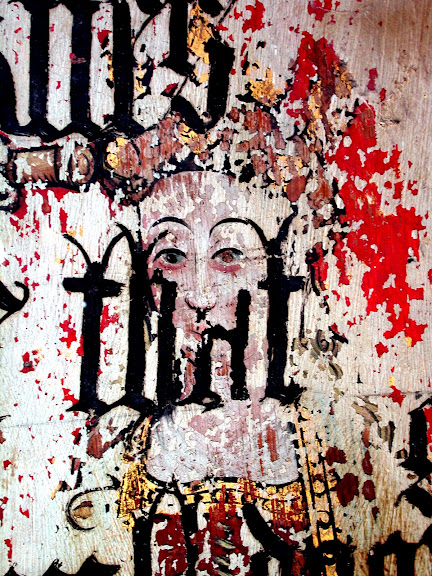
These two photographs were taken inside Binham Priory in Norfolk. The remains of the old rood screen were displayed behind a protective perspex sheet. What is remarkable is that over time the original medieval paintings have begun to show through the later post-Reformation overpainting, which was done in white with Gothic black-letter texts from Cranmer's Bible of 1539. Quite simply the people were obliterated with words. They were painted out of the picture and lost to sight.

For me these images are a salutary warning for the post-GAFCON church. They are a visual metaphor for troubled times. They caution against painting anyone out of the picture and pretending that they don't exist or that their views don't matter. They warn of the power of words.

Perhaps they illustrate too the contemporary tensions between the differing ways of understanding culture, faith and bible which led to GAFCON. In these images two worldviews exist in mutual contradiction in paint, which pretty much sums up where we are.

And what of God in all this? When Jesus says "You have heard that it was said, ‘You shall love your neighbour and hate your enemy.’ But I say to you, Love your enemies and pray for those who persecute you," (Matt 5:43-44) he offers us a way out of the sterile ingroup/outgroup standoffs which litter the world. Genuine peace and reconciliation becomes possible when we stop demonising the 'other', scapegoating the 'other' and stereotyping the 'other'.

It happens when we see through the overpainting with words to see the 'other' as a person. It happens when we realise the deeply human truth of what Southern Africans call Ubuntu, as championed by Desmond Tutu: ‘God's dream is that you and I and all of us will realise that we are family, that we are made for togetherness, for goodness, and for compassion. In God’s family, there are no outsiders, no enemies. Black and white, rich and poor, gay and straight, Jew and Arab, Muslim and Christian, Hindu and Buddhist, Hutu and Tutsi, Pakistani and Indian—all belong. When we start to live as brothers and sisters and to recognize our interdependence, we become fully human.’ You might want to have a look at Nelson Mandela describing ubuntu in this video

This realisation of our God-graced one-ness may yet help us to hold together in our tensions and disputes, for we are all made in God's image. And God sees through the overpainting.


Love, look at the two of us

Strangers in many ways

Let’s take a lifetime to say

I knew you well

For only time will tell us so

And love may grow for all we know

FOR ALL WE KNOW (Fred Karlin / Robb Wilson / Arthur James)

Sunday, 29 June 2008

GAFCON and the pilgrimage of faith

With the publishing of the Jerusalem Declaration our Anglican sisters and brothers have woken up today to a new reality within their worldwide communion as GAFCON establishes a church within a church. Naturally enough tensions are high and it will take a while for the more local, practical implications of this initiative to become clear. Methodists like to believe that we are the friends of all and the enemies of none, to quote John Wesley from our friends in the Methodist Church in Ireland. If this is true then perhaps we can offer loving listening and prayerful space to those for whom this is all so trying and emotive. Now 'like' Methodists will feel a natural affiliation with 'like' Anglicans on this one and I can envisage how such support would be welcome. However, will it be the best support that we can offer as ecumenical friends if such conflict is to be transformed - and I mean transformed rather than resolved? If we take a leaf out of the BBC's book a really helpful way forward might be to take a neutral stance and simply offer a holding space for very divergent views to be expressed. Take a look at this helpful side-by-side contrast of conservative and liberal viewpoints on the BBC News website to get a sense of what I mean.  I say this out of my own learning within our Methodist context on this one. So far we have resisted schism and have held together. This has been anything other than easy as genuinely making the attempt to pilgrimage together is profoundly sacrificial and involves compromise and give and take; its much easier to throw one's toys out of the pram and stomp off.

The Pilgrimage of Faith in the Methodist Church concerning our resolutions on human sexuality depends for its success or otherwise on our ability to enter into the worldview of those with whom we disagree and, with openness and honesty, dialogue, listen and learn: "In this context, to talk of ‘pilgrimage’ is to envision a journey the exact nature of whose destination is unknown, yet one that is worth taking because of the company of other pilgrims whom we encounter along the way. Different people will travel at a different pace; sometimes events may affect the direction: at other times, personal choice may affect the direction." (2005 report to Conference)

As the report to the Methodist Conference in Scarborough observes: "There are many Methodists who continue to struggle with the Resolutions. Some people see contradictions within the Resolutions themselves, whereas others disagree with part or all of the Resolutions. All people should be supported, and not be made to feel as though they are being asked to conform to a uniform view.The Resolutions are not easy for us to live with - this fact must be recognised by the Church. ..For many people this issue remains deeply personal and difficult to deal with"

So what practically can we do? A refreshingly different clue comes from Brian McLaren, which I picked up from the Emergent Village blog. Brian is responding to this question:

Ok, to my question. I find myself in trouble in my local congregation because I have read and taught from your books. I was recently called a heretic ... HOW, does someone who finds herself as "emergent" exist in a local congregation that is more comfortable with closed systems, black and white answers, rigid orthodoxy and legalistic orthopraxy? I love my church, but feel I am no longer a fit, the problem is, in searching for another system, there are not many churches that have progressed, if I may use that term, to this more "generous orthodoxy."

Brian turns to our imaginations as a resource and offers the following insight:

First, I need to tell you that you're not alone. I hear from so many gifted young leaders like yourself who are facing the same struggle. You're not only not alone now, but this is a common experience back through church history. For example, imagine what it would have been like ...

- to have accepted the unconventional pattern of St Patrick or St. Francis in a church that considered them to be extremists.
- to have believed that Copernicus and Galileo were right about the earth not being in the center of the universe ...
- to have accepted ideas of the Reformation in a church that wasn't yet on board.
- to have become an abolitionist in one of the vast majority of churches that were pro-slavery in the 1830's or 1840's.
- to have believed that Dr. King was right and Jim Crowe laws were wrong in the 1950's or early 1960's here in the US, or to have believed that Apartheid was wrong in white South African churches through the 1980's.
- to have resisted the agenda of the Religious Right in churches that were accepting it hook, line, and sinker in the 1980's and 1990's and early 2000's ...

I know that doesn't solve your problem, but I hope it gives you some perspective. To be faithful to Jesus is a rough go more often than not.

I find this approach really helpful. It helps me to get inside the divisive issues of sexuality and biblical interpretation from a dynamic which has the potential to transform the way such contentious matters of ingroup / outgroup are handled. However, to really do this you have to go one step further than Brian suggests and flip the imaginative task over to enter into the experience of those who resisted the innovations he lists. In each case I wonder what  it would have been like for them to have their cherished bedrock of belief shaken by the tremors of paradigm shift, along the deep theological fault lines beneath their feet?  I believe that we have to keep on listening to one another in this way, entering as far as we can into the space of the other with empathy, humility and unconditional positive regard. There is no quick fix, just a long, difficult journey together.

With this in mind I find that Sara Savage and Eolene Boyd-Macmillan from the University of Cambridge offer much practical wisdom on how our journey can be understood, re-framed and transformed in their excellent book The Human Face of Church. Here are a few significant snippets:

In churches, conflicts will continue to arise over different interpretations of scripture, moral values, mission priorities, worship style, leadership structure, finances...the list is endless. In an age of traditional church decline, the very notion of church is itself undergoing redefinition as fresh expressions of church emerge. Our headline should read: 'Expect more - not less - conflict!'

To repeat our mantra: conflict can be a positive learning experience...through conflict, our reflective processes deepen, our capacity for coping with cognitive dissonance expands, and our ability to interact with people with whom we disagree develops....

Yes, the difficult person in your church might be you. Due to stress, problems at home or work, you might be the difficult person around whom your faith community tiptoes. Learning to care for yourself might be the most important gift you can bestow upon your church...We're talking about protecting yourself from habits like taking everything personally, feeling indispensable, allowing yourself to be bullied, trying to control everything, or simply forgetting how to laugh...

We will never arrive at a pain-free, problem-free faith community...It is impossible to attain a static, problem free state - unless we are dead. If we are engaged in fresh expressions of church with the hope of getting away from the unresolved pain of traditional church, then we will slam into disappointment like a brick wall.

A recipe for survival contains ingredients such as: realistic expectations towards faith communities, fresh or traditional. Shake together and bake. Then wrap in a generous, varied patchwork quilt of 'self pastoral care'. By this, we do not mean self-help strategies, but a commitment to spiritual growth in community with responsible self-awareness. Humility will help us survive those inevitable winters of discontent: humility concerning ourselves, the church, God.'

It is that last sentence which gets me and I offer it to our Anglican sisters and brothers. Maybe the opposite of certainty is not uncertainty, but humility. Humility is the earth out of which God can grown new and beautiful expressions of what it means to follow Jesus in our time and place.

Saturday, 28 June 2008

Imaginative fusion: two responses to Celtic Imagination No 11

The image of the table and chairs has drawn two really creative and honest responses from Sally and Danny. Have a look and see what you think of this imaginative fusion around just one image. Perhaps this gives us an insight into how worship can be an act of the people rather than the views of one person, when the Bible liberates our imaginations and the Spirit weaves together a rich fabric of grace from the many threads of our creative engagement. Just a thought.

Thursday, 26 June 2008

Say seize the day and ride the gospel of absurdity

absurd: that which is plainly opposed to received notions of propriety and truth

I love this photo of our daughter Judy, who has just finished her first year at University. It was taken on a cycle path as she and her friend Anna revelled spontaneously in a gloriously absurd moment of joie de vivre. That's my girl, go for it Jude!

To me it just sums up so much of my own philosophy of life and approach to theology: carpe diem - sieze the day - this is not a dress rehearsal. It probably also shows what a good nonconformist looks like. And let me simply say that in my experience it really helps to have a highly tuned absurdometer if you are to survive life in the church. A rather sneakily absurd thought is to wonder whether the reason Jesus said you can only really get the Kingdom of God if you come at it like a child, is because kids do carpe diem with such innate openness. These two great videos by the Icelandic band Sigur Ros show what this looks like and just what we as adults have lost (Hoppipola = 'dancing in puddles').

Of course 'Carpe Diem' is at the crux of one of my favourite movies, Dead Poets Society. Robin Willams plays Mr Keating, a progressive teacher of English Lit at an appallingly stuffy and repressed private school in the States - a glorious metaphor for just about any institutional target you care to choose. Keating is an archetypal non-conformist, a person highly tuned to revel in the absurd. He gets the students to stand on his desk as a reminder to look at the world in a different way. With Carpe Diem as his watchword he takes some words of Henry David Thoreau as his hallmark:

and not, when I came to die, discover that I had not lived …  I wanted to live deep and suck out all the marrow of life

The Jesus I meet in the gospels wants us to live deep. In his life I see the stunning gospel of absurdity turning established notions of power, status and purpose upside down and inside out. It is this gospel, the absurd gospel of the Kingdom of God, which is re-energizing and re-envisioning the church in our time. The photo of Judy depicts exactly how I felt at the end of the recent RUN Conference in Peterborough, where Brian McLaren was so inspiring. Carpe Diem - seize the day! So to close my absurd ramblings I offer you the delicious absurdity of ASJ Tessimond's wonderfully provocative poem Heaven. In these extracts he cycles the gospel of absurdity to the max, and to great effect. It begins with the line, 'In the heaven of the god I hope for (call him X)', and contains these delightfully challenging images. Hang on tight and enjoy!

Here on the gates of pearl there hangs no sign
Limiting cakes and ale, forbidding wine.
No weakness here is hidden, no vice unknown.
Sin is a sickness to be cured, outgrown.
With the help of a god who can laugh, an unsolemn god
Who smiles at old wives’ tales of iron rod
And fiery hell, a god who’s more at ease
With bawds and Falstaffs than with pharisees.

Here the lame learn to leap, the blind to see.
Tyrants are taught to be humble, slaves to be free.
Fools become wise, and wise men cease to be bores,
Here bishops learn from lips of back-street whores,
And white men follow black-faced angel’s feet
Through fields of orient and immortal wheat.....

And X, of whom no coward is afraid,
Who’s friend consulted, not fierce king obeyed;
Who hears the unspoken thought, the prayer unprayed;
Who expects not even the learned to understand
His universe, extends a prodigal hand,
Full of forgiveness, over his promised land.

I long for a church where everyone's invited to the party: thoughts on Celtic Imagination No 11

One in five gay people suffer hate attacks.  Just pause and read that again. This headline from today's Guardian stopped me in my tracks and led me to at least try and imagine what it feels like to be a victim of this sort of hate crime. And what of these shocking images of last months violence in Johannesburg which show the reality of hate crime at its worst?

Stories like these bring me back to this photograph and that solitary chair, placed well away from the table. What must it be like to know that you are not welcome? What must it be like to know that who you are at the very heart and soul of your being is unwanted, rejected and spurned before even a word has been exchanged or a hand extended in greeting? And all this on the basis of just one descriptor amongst so very many which help to describe the shape of your life to other people.

Why is it that a person's sexuality, the colour of their skin or their ethnic origin can be such a decisive and divisive issue, whereas their stance on poverty, hunger, justice, debt-relief, world trade, peace, and global warming, is usually not? These are the issues which are truly decisive and important to our collective wellbeing whereas someone's sexuality or skin pigmentation is about as relevant as the colour of their eyes.

For a number of years now I have used the excellent website Preaching Peace, which is informed and shaped by the work of Rene Girard. 'Preaching Peace' applies Girardian theory to Christian theology and helps us to understand and counter mechanisms of violence and scapegoating in the world and to appreciate how the life and teaching of Jesus undermines such mechanisms. Perhaps this is why one of the many aspects of the emergent church movement which attracts me is their refusal to be drawn into divisive statements or behaviours - have a look at their values and practices and you will see what I mean. They live with diversity and differing opinions. They practice a wholesome and generous hospitality where all are welcome around the table. They put into practice the theology which lives peacemaking and avoids the mechanisms of scapegoating.

So little while ago, as I reflected imaginatively on the photo and tried to enter into it, I wrote this prayer: 

Loving God,

As we follow Jesus

You call us to lives of intimacy and solitude.

When we need to sit apart,

Bless us with the refreshing of your Spirit.

When we are left out,

Bless us with the companionship of your Spirit.

When we have missed out,

Bless us with the wisdom of your Spirit.

When we want out,

Bless us with the encouragement of your Spirit.

When we sit together

Bless us with kindliness of your Spirit,

That we would welcome

all whom you call to sit with you

at the open table of your kingdom.

Tuesday, 24 June 2008

Robert Mugabe: Thoughts on Celtic Imagination No 8

SOME STARK FACTS ABOUT ZIMBABWE[MugabeAd.jpeg]

INFLATION

In 1987 inflation averaged 11.9 percent. It surged to an official record of 100,586 percent in January 2008, but economic experts say the real rate is much higher.

LIFE EXPECTANCY

Average life expectancy dropped from 63 years in 1990 to 37.3 years in 2005, according to World Bank and U.N. figures.

UNEMPLOYMENT

Estimated at about 80% of the working population.

ROBERT MUGABE

Lives in a palatial mansion and is addicted to power. Uses violence, brutality and coercion to achieve his aims.  

THE PEOPLE OF ZIMBABWE

The majority are hungry, disenfranchised and powerless to put an end to Mugabe's megalomaniacal tyranny.

OK. The last two categories are not facts, they are my personal opinions about the unfolding tragedy in Zimbabwe. I happen to believe that they reflect the truth of the matter. On his campaign poster Mugabe expresses opinions of his own. The call-out which proclaims "100% empowerment. Total Independence" is a sick joke right out of the pages of the dictators handbook. Mugabe's record in government itself, let alone the recent accounts of beatings, murders and rape, tell an altogether different and horrendous story. If he believes that "All good things are possible", then that is a truism reserved for himself and his political cronies and military thugs.

Paradoxically, the sooner Mugabe is gone and proper democracy is restored to Zimbabwe the sooner its people can begin to experience the reality of his campaign slogan. The picture of the mooring post is an apt metaphor for what has happened to Zimbabwe under his rule. Mugabe has failed utterly to care for and empower his people. This failure right at the centre has compromised the whole country and imperilled its people.

But look again at his poster. Are there some inconvenient truths here for Brits like me? When I was a lad I can remember looking at maps of the British Empire in books. Great swathes of pink coloured the map. It all seemed so natural and normal. In History Class we learned of the Indian Mutiny and the Black Hole of Calcutta. On television the violence in Northern Ireland was told from the normative perspective of us being at war with the terrorists of the IRA. As a child growing up I knew no better and my worldview reflected it. History was always one-sided and incomplete. A whole set of voices were missing. I can just recollect John Pilger's reporting from Vietnam striking a discordant note on our black and white TV. Voices and pictures from the underside of history started to tell a very different story about the world I took for granted. Gradually I came to see the story of Empire from an altogether less rosy viewpoint: that of the British Empire doing what Empires always do: conquer, exploit, oppress and subjugate native and indigenous peoples.

Try reading Irish History from the Republican perspective and it all looks very different. Take the interplay of landlordism, the potato famine and mass migration for example. To some Irish commentators this catastrophe of 'the great hunger' is nothing less than a 'managed genocide'. These are voices which we have needed to hear. The same applies of course to American history and the colonisation of North America. The French, Spanish and British all devasted the native peoples; it was left to the westward expansion of the white settlers in the late 19th century to finish the job. Films such as Dances with Wolves and  books such as Bury my Heart at Wounded Knee attempted in part to set the popular record straight, but the pace of revisionism can seem heartbreakingly slow. And what of Africa and the Middle East? As a palaeoecologist I knew that you could not make sense of the present without understanding the past. So as I condemn Mugabe I am tied inextricably to the colonial history of my own country and its imperial past. Mugabe has not only played on this, one could argue that he has been made by this history. The picture of the white guy in the pith helmet being carried by two Africans and Mugabe's facts about colonial rule reminds me of Desmond Tutu's sharp saying: "When the missionaries came to Africa they had the Bible and we had the land. They said "Let us pray." We closed our eyes. When we opened them we had the Bible and they had the land." As we hope and pray for Mugabe's removal from power I think it only honest that we recognise our complicity in so many of the world's political dilemmas.

Open source Christianity and the blogosphere

Thanks to Tony Jones in his superb book on the phenomenon of the Emergent Church Movement, 'The New Christians', I have just discovered Bob Carlton's blog and this refreshingly perceptive and honest post on men in leadership in the church, and the neglected testimony of women.  And thanks to Bob Carlton I have just discovered the blog and artwork of Jen Lemen, and re-read this lovely quote from John O'Donohue, one of my favourite writers.

unseen life

A sentence read in a book, a quick Google and a couple of mouse clicks and my soulspace has been expanded and enriched, all inside 10 minutes. This is the reality of open-source Christianity and the blogosphere. Tony Jones explores this theme at depth, emphasizing that "Emergents believe that church should function more like an open-source network and less like a hierarchy or a bureaucracy." He cites Wikipedia as a good example of this, with anyone able to edit the content in such a way that it is the community itself which produces the text we read on the screen collectively and collaboratively, rather than it coming from a single authoritative source.

In a Wiki model of church the people do theology together, do liturgy together (lit. the work of the people) and transform their communities by living 'beautiful Christianity' together: "Emergents firmly hold that God's Spirit - not their own efforts - is responsible for good in the world. The human task is to co-operate with God in what God is already doing."  Of course such open-source statements as "Emergents downplay - or outright reject - the differences between clergy and laity" threaten hierarchical, status-bound institutional churches - and thank God for that. As I prepare to go to the Methodist Conference in Scarborough next week, this sublime quote from Tony Jones is a God-gift:

"Lillian Daniel is a pastor in the United Church of Christ, a notoriously left leaning denomination founded in 1957.She's also active in the labor movement and an outspoken proponent of progressive causes - a passionate person. Reflecting on the biannual General Synod national meeting, she moaned, 'We used to be a group of revolutionaries.  Now we're a group of resolutionaries.'  Operating by a distinctively non-biblical Robert's Rules of Order, she said the convention has devolved into a gathering of persons who read resolutions that are then voted on and promptly forgotten.  The resolutions range from those for gay marriage to those against gay marriage, from a call to study the imprisonment of native Hawaiians to 'saving Social Security from privatization.' The resolutions pile up; and then they're read, seconded, discussed, voted on, and filed.'  Lillian thought she was joining a movement, but she was joining a bureaucracy.  And that bureaucracy tends to squash the passion of many Christ-centered and enthusiastic persons therein."  (The New Christians pp. 9-10)

There is a beautiful, messy godly simplicity to re-discovering church not as an institution bound to buildings and resolutions but as a transformative and revolutionary community of disciples. Disciples for whom parity of esteem and mutual respect and living out kingdom of God lives as followers of Jesus, are key. Have a look at a sample of Shane Claiborne's writing to get a flavour of what this approach feels like.  Bob Carlton has this lovely quote from him: "I see an entire generation of young people who want a Christianity they can wrap their hands around.  They don't want to just believe stuff. They're saying if you want to know what I believe, then watch how I live." If this sort of thinking floats your boat get a copy of Tony's book. In an open-source church we share the insights we have discovered, we are enriched by one-another and we are open to God's Spirit, continually weaving fresh patterns of meaning and hope in the midst of life.

So to another gift from Bob Carlton's blog, the poem 'teach us a new language' by Cheryl Lawrie, project worker for the Hold This Space alt.worship project in Australia.

We are trying, God,
and we are angry that the world will not listen
when we try to speak of you,

yet deep down
we acknowledge that we no longer have the words
that speak of who you are
and all you have done.

While we know it is no sin to be speechless,
we must confess that we have stopped looking.

Teach us a new language, God -
one of wild imagination and courageous vision -
so we can begin to tell a new story
that will unfold your ageless plot of freedom
liberation
and grace
to a world longing to hear.
A story that will speak of hope with the turning of each page.
A story that you promise has no ending but love

Coping with stress: thoughts on Celtic Imagination No 7

This image works for me on many levels. As someone with a busy, demanding job I recognise the feeling of being under continual pressure, of holding the weight of difficult issues and situations for prolonged periods of time. On several occasions I have learned the hard way how such unremitting stress has a nasty tendency of catching up with me. I know what it feels like to be off work and just another statistic in time lost to the British economy through stress-related illness. After the last such episode I decided to do something positive to break the cycle.

Whilst on sabbatical in 2006 I had read some of Zen Master Thich Nhat Hanh's books and was attracted to his practice of mindfulness. A quick Google search soon turned up the fact that these techniques had been introduced to medicine as a way of reducing stress and improving wellbeing. I discovered the work of Jon Kabat-Zinn, the founder of the 8 week course in mindfulness based stress reduction (MBSR) at The Center for Mindfulness at the University of Massachusetts Medical School, and read his book Full Catastrophe Living. He speaks about MBSR in this video from the University of California San Diego Center for Mindfulness, which is well worth a look if you are interested in exploring mindfulness for yourself. A much shorter introduction to what MBSR is about is the excellent book Heal Thyself by Saki Santorelli, one of Kabat-Zinn's colleagues.

All of this reading was like becoming aware of the smell of fresh bread; you just have to taste some for yourself. Thankfully it is possible to take the 8 week course in MBSR via distance learning in the UK. I signed up for the one offered through the Centre For Mindfulness Research And Practice at the University of Bangor. This involves daily home practice and a weekly 45 minute phone call with a tutor, with an optional day of silent practice in Bangor for everyone on the course. Put simply, it has changed my life. But be warned; the course opens up all sorts of painful self-awareness, not least of our automatic ways of coping with stress and deep-seated and unhealthy patterns of thinking and negative self-talk. Yet the essence of mindfulness is that it cultivates a freeing non-judgemental awareness. In my experience it brought the promise of Jesus alive: and you will know the truth, and the truth will make you free (John 8:32).

Anywhere at anytime I can simply focus on my breathing and be myself in the present moment. It feels rather like immersing myself in a warm bath and relaxing deeply.  If situations get tough and unpleasant it is simplicity itself to use the 'three minute coping with difficulty breathing space'.  Living in the present moment, giving attention to the present moment, being aware that thoughts are not facts and being gentle and non-judgmental when negative self-talk arises  has transformed the quality of my life. I now cope with stress and truly feel that the rusty hinge won't fail.

In Christian terms MBSR has led me to experience in the most profound way what it is to be still, and know the healing and delightful presence of God in each moment. The serenity prayer of Reinhold Neibuhr really does come alive when we practice moment-by-moment awareness.

God grant me the serenity to accept the things I cannot change,
courage to change the things I can,
and the wisdom to know the difference.

Friday, 20 June 2008

Celtic Imagination No 11

A simple composition which might lead to you to reflect upon such themes as inclusion and exclusion, acceptance and rejection, intimacy and solitude.

 Hothorpe Hall, Leicestershire

Celtic Imagination No 10

A more sombre image to dwell with.This photograph was taken in the churchyard at Howarth, West Yorkshire, adjacent to the Bronte Parsonage Museum. The inscriptions point to interwoven stories of death and dying, grieving and loss within one family.  The earliest death is recorded just two years after that of Charlotte Bronte. The leaves of the Horse Chestnut tree counterpoint the Victorian headstone.

Howarth

Friday, 13 June 2008

Celtic Imagination No 9

This photograph of a ladder stile was taken from the Ordnance Survey Trig Point on Black Crag, on a very hot day in bright, hazy sunshine. I find it a very imaginative image to work with. The wall blocks the path, which carries on into the middle distance. Climbing over the stile is the only way to get to the other side. The second step up  is missing, as is a plank on the top platform. The 'usual' walking routes turn back at this point; there is no finger post to say where the path leads, so this is a significant boundary to cross.  The dramatic scenery of the far horizon beckons the viewer. If you are fit and healthy you might want to climb over and explore, but what if you are not, or if you have small children or a dog? What can you draw out from this image about boundaries and barriers?

Ladder stile on Black Crag, near Tarn Hows in the Lake District.