Tuesday, 30 June 2009

the ever present danger is that we will destroy that which we do not value

bryn cader faner snowdonia

Regular readers of this blog will know that I have  an affection for ancient monuments, especially those from the earliest periods of our prehistory in Britain. I find the sense of sacred mystery which enfolds such sites really attractive: a good dose of the unfathomable and impenetrable is good for my soul I guess, especially when it is combined with beauty, artistry and a palpable sense of human achievement and expression. These places are precious for they are part of the story of who and how we are; they are waymarks on the spiritual and cultural journey which has led to here, now and today.

It is all the more vexing then when one discovers that such a site has been vandalised - perhaps the word should be desecrated - at some time in the past. One such example is depicted here: the Bryn Cader Faner bronze age ring-cairn in  North Wales. Treasure seekers in the nineteenth century and soldiers in the twentieth have all taken their toll on the monument. Clearly each group had another purpose in mind which took precedence over the cairn circle, regardless of its antiquity or archaeological value. Bernie Madoff took a similar approach to the wellbeing of the investors he ripped off and ruined. Short term personal gain so often proves more powerful than long term collective good. Which is why we are frying the planet with human-induced climate change.

bryn cader faner bronze age ring cairn snowdonia

The Christian Faith takes a diametrically opposed view to this selfish outlook. We speak and act out of a conviction which prizes interdependence, mutuality and the long view. We seek to uphold the intrinsic value of everything from people to landscapes and complex ecosystems. They all have inherent worth, and should be treated and regarded respectfully and carefully. When everything is seen as sacred one treads gently on one's path through life. Loving-kindness and justice are expressions of this way of looking at and being in the world. 

The ever present danger is that we will destroy that which we do not value. The present state of Bryn Cader Faner is a simple and stark warning from history concerning our cavalier attitudes to the planet and the people which are our home. Before a stone was displaced and the cairn disturbed there was a real need for the contrary view to be put and upheld.

In today's world that is our ethical task. And the stakes have never been higher.

bryn cader faner bronze age ring cairn snowdonia close up

Monday, 29 June 2009

Fortifying faith without limit

40mph limit railway speed restriction sign

An image for use in worship and personal reflection

You can play with the sense and meaning of this sentence in any number of ways. Naturally the irony is intentional. Some see faith as being fortified by limits, restrictions and exclusions. Others maintain that faith can only be strengthened when love is unlimited. Where do you stand?

Sunday, 28 June 2009

the shape of divine love in the life of Jesus always casts light on the challenges of today

the shape of divine love in the life of Jesus always casts light on the challenges of today

An image for use in worship and personal reflection

(click on the image for a larger version)

Friday, 26 June 2009

disempowering patriarchy

disempowering patriarchy constantine york minster

Here is a cover waiting for a book if anyone is minded to write it.

As you see it is both a statement of fact - patriarchy is disempowering - and a vision for one way in which the  church might be remade in God's image - disempowering patriarchy.

I offer the image as my response to the funeral of my Aunt, which was yesterday.

The service took place in an Anglican parish church which does not welcome the priesthood of women and which is under what I believe is called 'alternative episcopal oversight'.

The priest who conducted the service was well meaning and very sincere.

As a Methodist presbyter, however, I found myself in a foreign land and could not separate the specific act of celebrating the life of a remarkable and much-loved woman from the surrounding context of an ideology of gender exclusion.

How can 'power patriarchy' be anything other than a blight upon both church and gospel? How can silencing women and excluding them from key roles in leadership be 'according to the mind of Christ'? Get a life.

The gospel I read tells me that Jesus empowered the powerless and included the excluded.

The picture of the statue of Emperor Constantine outside York Minster is not a criticism but a whopping question mark concerning power in the church, any church.

Does God weep or rejoice that women are excluded in this way?

I don't hear divine blokey-bloke laughter at this iniquity. And tears fall silently. But the hurt is real.

Wednesday, 24 June 2009

well-worn steps of faith

well worn stone stairway


Well-worn steps of faith

the soul-making way to God

and true-self.

Fresh expressions

emerging church

alternative worship

the latest cachet enhancing

unchurched attracting

ideas and inspirations

all lead here

eventually

don't they?

The footsteps of Jesus.

The dark night of the soul.

So many feet

so much hope

such great love.

Each step a 'yes': the pathway of assent into God.

___________________________________________________________________________________________________

Sally has written a great  poem to go with this image. See Danny's helpful post too.

Sunday, 21 June 2009

shape without substance and form without power

shape but no substance

Bourton-on-the-Water

It has the recognisable shape of a first generation Mini, but.....it's a classic case of shape without substance and form without power. It resembles one thing but is actually something quite different.

'Shape without substance' may well have been on John Wesley's mind when he penned his  "Thoughts Upon Methodism":

"I am not afraid that the people called Methodists should ever cease to exist either in Europe or America. But I am afraid, lest they should only exist as a dead sect, having the form of religion without the power. And this undoubtedly will be the case, unless they hold fast both the doctrine, spirit, and discipline with which they first set out."

In our Methodist understanding then,

To try and do church without being totally open to the lovingly creative power of the Holy Spirit would be a bit like trying to drive this garden planter: don't be surprised if you get nowhere fast. Yet still we reach for the keys.....

And to try and do church without an active commitment to social justice and the poor would be to have the form of religion without the power too (read Blake Huggins post for more on this)

Shape without substance and form without power is both a warning from our collective past and an encouragement for our collective future: in all things we can ask the question of ourselves, what shape and form should the church adopt in order to express the revolutionary transformative substance of the gospel and the powerful liberating presence of God's grace?

Saturday, 20 June 2009

Christianity: a lens and a window onto other worlds

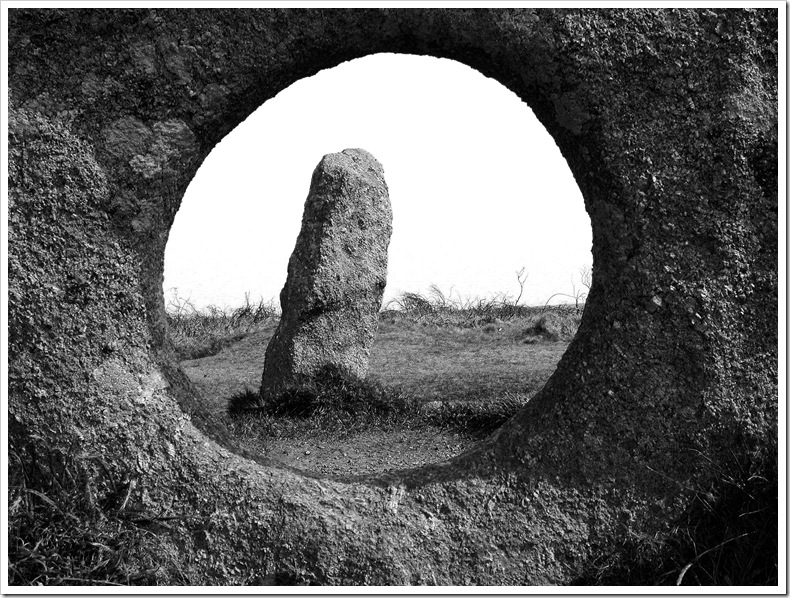
Men-an-Tol  (lit. holed stone) is an enigmatic megalithic structure in the far west of Cornwall. Sadly for us its original meaning and significance are forever lost and irrecoverable in the dead silence of the oral traditions of our prehistory, as is the case with the Rollright Stones and Northumbrian prehistoric rock art. A2M, the online guide to Cornwall's archaeological heritage, says this about Men-an-Tol:

a recent site survey identified a number of recumbent stones lying just beneath the modern turf which were arranged along the circumference of a circle 18 metres in diameter. ...If this is indeed the origin of the site, the holed stone would probably have been aligned along the circumference of the circle and would have had a special ritual significance possibly by providing a lens through which to view other sites or features in the landscape, or as a window onto other worlds.

It is that last provocative sentence which triggered my train of thought in this post. Christianity is a religion in which the original meaning and significance of the life and death of Jesus is known and recovered through the passionate praxis of contemporary disciples every bit as much as it is through the scriptures, doctrines, traditions and theology of their predecessors in the faith. Looking at Mel-an-Tol today we are left in the dark about its ritual and sacred value in the culture of its time, as the flow of praxis was broken and the story lost. Not so with Christianity. We have 2000 years of richly diverse spirituality to inform our understanding; two milennia of theological reflection, discipleship and ecclesiology to consider. The line is unbroken and the story is still strong.

The world may sometimes look with puzzlement at what we do and the things we say, a bit like modern tourists looking at the stones of Mel-an-Tol and thinking "what is this all about, what does it mean, why is it here?", but we are here, and here to stay. The down to earth realities and truth of our faith are as strong and vibrant and pertinent now as they were when Jesus broke bread with his friends. Jesus was a  lens and a window onto other worlds: the roman imperial world of political violence and socio-economic oppression, the Jewish religious world of power and exclusion, the ancient world of sickness and death, the cruel world of hunger and poverty, and most of all the living world of God's presence and love for all.

The challenge to the church of today is to avoid becoming an enigmatic monument disconnected to the story, experiences and needs of contemporary humanity.  To remain in touch and connected it is imperative that we continue to offer what humanity seems to value highly, that lens and a window onto other worlds of meaning and significance. Surely it is vital that we continue to offer and live out alternative ways of seeing each other and the world in which we live; framing for ourselves and others the world as Jesus sees it. One thing is certain, looking through the lens and window of Christianity there are many worlds to be seen: the world of gross economic inequality and social exclusion, the world of racial hatred and ethnic violence, the world of mental illness, the world of gender injustice, the world of loneliness and despair, the world of climate change and environmental degradation, the world of exploitation and trafficking, the world of HIV/Aids, the world of war and terrorism. And there are so many more besides.

Not least the worlds that Jesus saw so very clearly: the world of political violence and socio-economic oppression, the religious world of power and exclusion, the world of sickness and death, the world of hunger and poverty, and most of all the living world of God's presence and love for all.

We look at these worlds through the lens and window of Jesus Christ, whose God-story is always and forever our story too.

Wednesday, 17 June 2009

The squeeze

the squeeze on side pike 2lingmoor fell and side pike mapHaving read about 'the squeeze' in a fellwalking guide to the Lake District, I just had to see it for myself. You have to pass this way to get from Side Pike onto Lingmoor Fell if you want to avoid having to backtrack almost to the road. The precipitous sides of the crag offer no other direct alternative to the path you see in the photo, which is viewed looking back to 'the squeeze' itself. This narrow passage on a small rock shelf is at best only about a foot wide. If you didn't know that it was just around the corner it would come as a very unwelcome surprise. I wonder how many unsuspecting folk have come this way over the years only to find that 'the squeeze' is impassable? Just imagine how frustrating it would be to have to turn back and retrace your steps all the way back to the road, when your goal is in sight. 

Is 'the squeeze' an unsettling visual corollary to the way that the side pike squeezeChristian faith is commonly perceived? You can look at it and think that this is all about what you must not be in order to get through. In other words it is a judgemental negative cipher for how one achieves godliness, a brutal and blunt filter which is about exclusion and denial, rather than inclusion and affirmation.  You have to put stuff down, take stuff off, become a 'lesser' person, to get through.

And if we turn to the Bible this does indeed seem to be the sense we get. Matthew 7:13-14 uses 'squeeze' imagery to get the point across and seems to leave little room for interpretative doubt.

Enter through the narrow gate; for the gate is wide and the road is easy that leads to destruction, and there are many who take it. For the gate is narrow and the road is hard that leads to life, and there are few who find it

But looking again we see that the narrow gate leads to life and is not a checkpoint at which we will be included or excluded from the Christian faith. If the spiritual starting point is the question of where on the spectrum of life in its fullness or emptiness we find ourselves, then the image of 'the squeeze' begins to have real pastoral potency. The point of the journey is that it is a pilgrimage in godliness, in becoming Christ-like. You do not need to be able to squeeze through the narrow one-size-only-if-you-are-to-fit filter in order to journey with Jesus. He does not wait on the other side of the squeeze as though it were a religious turnstile. That is not what the Bible is saying.

'The squeeze' reminds me that the life that I long to lead and the wholeness and fulfilment for which I yearn are not gained easily or without a struggle. There are attitudes, inner scripts, bits of baggage from the past, stubborn ingrained selfishnessess and behavioural blind-spots that I would do well to set down and leave behind. Such soul-work is demanding, often painful, seldom less than draining. The Bible is really honest about this: the gate is narrow and the road is hard that leads to life. And it is on this road that Jesus companions us. 'The squeeze' on Side Pike is a check and a question mark for this particular part of my journey as a disciple. And of course it's also a recurrent challenge and reminder, not a one-off point of passage.

I will have to leave behind nothing essential to my wellbeing . Far from it. The wonder and the joy is that getting through 'the squeeze' is about being more fully human, not less. It is not about squeezing out our joie de vivre and diminishing our capacity to relish life and make the most of it, the very opposite is true; it is about increasing these essential qualities as the shape of our living becomes more godly.

Wednesday, 10 June 2009

the craggy side of divinity

"Over the course of three centuries a tremendous revolution of perception occurred in the West concerning mountains. The qualities for which mountains were once reviled - steepness, desolation, perilousness - came to be numbered among their most prized aspects. So drastic was this revolution that to contemplate it now is to be reminded of a truth about landscapes: that our responses to them are for the most part culturally devised. That is to say, when we look at a landscape, we do not see what is there, but largely what we think is there. We attribute qualities to a landscape which it does not possess - savageness for example, or bleakness - and we value it accordingly. We read landscapes, in other words, we interpret their forms in the light of our own experience and memory, and that of our shared cultural memory."

Robert Macfarlane Mountains of the Minddow crag

Blessed be my rock,  and exalted be my God, the rock of my salvation (2 Samuel 22:47)

The Lord is my rock, my fortress, and my deliverer,  my God, my rock in whom I take refuge (Psalm 18:2)

The people standing on the skyline to the right of the summit of Dow Crag not only give a sense of scale to the picture, they also provide a clue as to why the Bible probably uses rock as an image of God. All sorts of connotations come to mind: the comparative sense of proportion puts our own lives into perspective, the sheer vastness and rugged solidity of the crag implies permanence and reliability, then there is the real awe which is engendered when you are overshadowed by such a wall of rock, and the breathtaking vista which opens up when you stand on the summit, which is so different to the view at ground level. In a world of threat and danger the Bible clearly sees such places as having a defensive military advantage too, as well as being good places to hide.

But of course the crag is a dangerous place to be too. It is not free from risk. There a real hazards which must be respected and over confidence can all too quickly lead to catastrophe, not least for inexperienced rock climbers and incautious walkers. And this is part of the thrill of such a place as this. Here you are right on the edge. You can push yourself to the edge of your experience and beyond and have the deep satisfaction of knowing that you have extended the boundaries of what you thought possible. Perhaps this sense can be discerned in the role that mountains play in the Biblical narratives: in such places God is met and humanity is challenged.

But there is a very different side to this metaphorical use of rock which open up a fresh perspective on the craggy side of divinity. Dow Crag is not unchanging and immutable. The base of the rock face is covered by a steep angled blanket of scree. These frost and ice shattered fragments of rock  have been torn away from the crag by the constant battering of the elements it has endured since the end of the last ice age, some 10,000 years ago. 

To me the scree  resembles countless tears falling from the face of God. It points to the cost and risk of such open, down to earth love.

Wednesday, 3 June 2009

light and shade

sunlit tree early morning light bannishead quarry nr torver lakes district

sunlit tree afternoon bannishead quarry nr torver lake district


About five hours separate these two photographs of a tree on a bright sunny day in the Lake District. Viewed from the western rim in the early morning light the eastern face of Bannishead quarry near Torver is in deep shade and the water appears dark . The tree is backlit from the left and its shimmering leaves stand out against the darker tones. By early afternoon the sun has moved round and is high in the sky. The tree is now lit from the right and the far wall of the quarry is in full sunlight.

You can judge for yourself just how different are the mood and feel of these two photographs, even though they were taken from an identical point of view.  Of course the tree hasn't changed; how we see it and our perception of its context has. In the early shot the tree stands out against the two large diagonal blocks of darker colour in the background, its shape and texture accentuated by the highlighting catching the leaves. Here it is the main point of attention. In the later shot the background has come to life and is much more detailed and busy, the shimmering coming this time  from the surface of the water rather than the tree. The lighting is flatter, and the tree competes for attention with its surroundings. Which photograph you prefer is entirely a matter of personal taste.

How we see one another and how we see ourselves - our self image -  is subject to similar sociological and psychological vagaries of light, shade and context. Moods, opinions and feelings can be as fickle as the interplay of light and shade in the photographs. They too are subject to changing with time. What we see can alter dramatically according to the sort of comparisons we draw with our own background and surroundings and those of others.

It is simply not possible for us to see someone as they are within themselves, nor for that matter, to see ourselves as others see us. Only God has such insight into the true nature of your soul and mine. This being so it is imperative that we hold fast to the truth that God is Love, and sees us and loves us as we are. No mood swings, no fickle feelings or changeable opinions: just the most tender and deep compassion for what it is to be you or me and an absolute commitment to bring us to wholeness and true wellbeing in mutual community with one another. In all probability this grace of vision and understanding is something we shall never attain, but it is at least something to which we can aspire.

Friday, 29 May 2009

hidden pentecost: a gentle hallowing

Pentecost is hardly subtle or quiet. The gift and work of the Holy Spirit is demonstrated with all the energy and boisterousness that one would expect from a room full of blokes suddenly tanked up on pure distilled divinity. From this in-spirited explosion of grace the good news of God's love in Jesus bursts across the ancient world like a shockwave of hope.

But somewhere close by, out of sight in the shadows, there is a memory of a quieter, gentler, yet no less profound work of the Holy Spirit.  Mary was blessed and her pregnancy was hallowed within the creative purposes of God. Such hallowing, or making sacred, seems to me to be much more typical of the love-making presence of the Spirit deep down in the everyday, ordinary stuff of  our lives than the pyrotechnics of Pentecost. Hallowing is often a quieter and less outwardly dramatic affair than the day when the disciples were energized by God,  such as one's heart being 'strangely warmed' as was the case for John Wesley, yet it is felt and experienced no less intensely by those whom the Spirit indwells.

It is this gentle, intimate hallowing that comes to my mind when I read St John's story of Jesus breathing the gift of the Spirit into his friends on Easter day.

Jesus said to them again, ‘Peace be with you. As the Father has sent me, so I send you.’ When he had said this, he breathed on them and said to them, ‘Receive the Holy Spirit. (John 20:21-22)

And of course all these different understandings and portrayals are valuable and necessary to our faith. As the birthday of the church it is right and proper that we collectively celebrate Pentecost with much joy and energy, as that is what this outpouring of God's love is all about. And in the midst of this it is also good to recall those gentler, inconspicuous and highly personal times of hallowing too. Such experiences are the continuing gift of hidden Pentecost.

Tuesday, 26 May 2009

Hope

hope station derbyshire hope does not disappoint us Hope Station, Derbyshire

If what we hope for doesn't turn up, what then? Should our dreams become waking nightmares, our expectations be crushed, our rights violated or our very soul torn apart by grief, what meaning has hope for us? Is hope a destination which is never reached,  a station at which trains never arrive? What sense is there in this little word which plays such a prominent part in the writings of St Paul?

I think that with its orientation to the future, hope is the liberating trust which Christians have in the presence of God who is constantly seeking to make all things new. The ongoing work of creation, the eternal artistry of love, is the very nature of the God in whom we live and move and have our being. I guess that for me, hope is aligning myself to God's love as it will surely and certainly be in the future. It seems to me that it can only be from this position of trust and spiritual security that Paul can state the conviction in the passage above so clearly. Such hope has the power to help us face the future, because come what may there is nothing love cannot face (1 Cor.13:7 REB).  All that is life-denying, degrading , hurtful and destructive is set within this post-Easter understanding. Pain, tragedy, loss and death are facts of life: they need not augur for the utter futility of hope. It is from the givenness of such aspects of human being as these that we have to fashion a coherent way of speaking hopefully.

There is a passage in the writings of Julian of Norwich to which I keep on returning. I think she displays a profound understanding of the texture of such hope when she says:

You will not be overcome.
God did not say you will not be troubled,
You will not be belaboured,
You will not be disquieted;
But God said, You will not be overcome

To be overcome, ultimately, would be to find oneself apart from God. Therefore hope does not disappoint, because God never abandons us. I think it is this truth which Paul unfolds in the quote above from Romans 5. To hope in and for the presence of God is to trust in a given of creation itself. And so we each become part of the others hope as God invites us to share freely in the work of new creation. God is love, so to share love is to participate in the never-ending process of hope-making.

In the epilogue to their book Hope Against Hope, Richard Bauckham and Trevor Hart turn to the work of the French catholic poet Charles Peguy for inspiration, and his picturing of hope as a small girl. They say that "while the small child may be a natural symbol of hope, hope is far from natural. Writing in the face of a dark future, Peguy thought hope an astonishing miracle, by comparison with which the two other theological virtues, faith and love (charity), seemed obvious and virtually to be expected. Faith sees only what is, in time and eternity, God and creation. Charity loves only what is, in time and eternity, God and the neighbour. " For Peguy hope is altogether more special, because "hope sees what has not yet been and what will be, she loves what has not yet been and what will be. In the future of time and eternity." Drawing on this Bauckham and Hart believe that "hope does not grow up. In an age of fading and lost hopes, this is, so to speak, the hope for hope. Hope must always be born anew: "the little girl hope is she who forever begins." (Peguy)

So the birthing of newness and the eternal becomingness of love are woven deeply by God into the fabric of despair and death which clothes our everyday experience. As such hope does not grow up; it is always freshly gifted by God, and does not disappoint.

Monday, 25 May 2009

Panopticon Vision: viral imaginative synergy in open networks

pendle panopticon exterior view

The 'Atom' Panopticon at Pendle is an amazing piece of interactive art.  From the inside the ferro-concrete structure  frames both the landscape and the sky, providing discrete circular views, each of which reflects onto the central stainless steel sphere. As one moves around within the 'Atom' the pattern of reflections changes, as does the focus of attention through each of the apertures. Of course at any one moment much of the surrounding countryside remains unseen. This mix of direct vision and reflection, of framing and light, is at once both powerful and thought-provoking. It is also a very individual experience of perception, imagination and interpretation.

pendle panopticonThe English philosopher Jeremy Bentham coined the term panopticon for his humanitarian design of model prison. The word as used today, with its sense of 'all in view', can carry negative connotations of one being under surveillance without necessarily knowing that this is happening. Our own government's panopticon fervour for a society under surveillance, with all the threats to civil liberties which this entails, is well documented. In the case of the 'Atom' sculpture  however, the word is blissfully neutral and simply refers to "a structure, space or device which provides a comprehensive or panoramic view".

Standing within the 'Atom' I was struck by the thought that here is a representation of how faith works. The shape speaks to me of our concrete worldview, that combination of values and beliefs which determine not only what we see but how we see it. Yours will be different to mine. The actual bits of reality that catch your attention need not be the same as those which catch mine. The reflections in the sphere give us an opportunity to try and put the bigger picture together. Here I am drawn to compare the sphere itself to the life of Jesus as disclosed in the bible and explored in theology. It is on this surface that we do our sense and soul-making, illuminated by the light of God's loving-kindness.

So your 'Atom' will be uniquely yours. And for the first time in Christian history we now have the means of sharing such individual panopticon visions of faith, spiritual viewpoints and theological reflections within and across networks, traditions, countries and continents at rates and in volumes which are quite unprecedented. It is hardly surprising then that the internet is now taken to be a participatory panopticon; what you think, see and believe can reach a global audience. Rapid change in Christian praxis is now a hard wired  consequence of the way we communicate in a digital world. As Mulder and Scully used to say, the Truth is Out There; now it can be in here , downloaded and making a difference  to me and my network with one simple click. Our global participatory panopticon is the collective experiential cloud of millions of 'Atom' viewpoints. Web 2.0 faith is a reality.

And within it ideas spread virally. The rise and spread of emerging ways of being church and their constitutive networks might be an example of such pandemic theology in action. Because such networks tend to be open the information within them is highly transmissible and can easily infect other networks too. Such digital reproduction has similar benefits to sexual reproduction in terms of  the continuing evolution of Christianity; the mixing of ideas and specific bits of praxis, like mixing genes,  increases the potential for adaptability, vitality and vigour in the face of a rapidly changing or heterogeneous environment. Such imaginative synergy is probably a real driving force for rapid change in our time. To be shut off from the pool of such genetic variation is to play the evolutionary equivalent of russian roulette. Denominations which dont or wont adapt face the prospect of extinction.

So each individual panopticon can play an essential part in the wellbeing of the whole global  faith community to a degree which was undreamed of only a few years ago. Viral imaginative synergy in open networks is here to stay; perhaps this is one way in which the Holy Spirit is bringing a new VISION to birth.

(With apologies for the contrived acronym.)

Friday, 22 May 2009

Tranquility

tranquility

Wednesday, 20 May 2009

imagining faith: a synergy of symbolism

cross, lifebelt and bridge

(as usual click on the photograph for a larger version)

I wonder whether the  person who hammered the wooden stake into the ground by the Lakeside at Swanwick saw it as anything other than something upon which to hang the lifebelt? If this act was simply just another tick on a health and safety checklist it has achieved in my mind far more than was intended. Coming across it for the first time I was struck by this powerful conjunction of symbols, set against the sky.  The next day I went back and took more photographs, of which this is one. This time I expanded the field of view to include the junction of the paths and the small wooden footbridge, beyond which the path leads on around the lake. The light and weather were different too, as the bright morning sunshine was about to be interrupted by an oncoming shower.

The photograph presents a synergy of symbolism. The cross, lifebelt, junction of paths, footbridge, sunshine and approaching rain speak to me of that timeless place where christian disciples seem perpetually to stand. What I mean is that somehow it is always like this. The challenge to take up our cross is driven into the ground right where we are standing, with all that is says about our commitment to that costly kingdom lifestyle of unconditional, transforming, liberating and prophetic love which was the way of Jesus. The cross is the fact and the future of christian faith as it reminds us of the cost and challenge of God's grace in a world like this. In his life and death Jesus discloses the very nature of God. On Good Friday the world throws the worst it can do back in God's face, as Jesus is executed as a radical revolutionary and the way of love is rejected. Easter Day is God's answer to all the worldly violence of Good Friday. Christ is risen and nothing can defeat the vulnerable love of God, which always rises up and comes back, now matter how many times and how hard it is trampled underfoot. And it reminds us that love is the eternal given of God, and that God's love is eternally present.

God's universal and unconditional purpose is consistent; that we should all have life, and have it in its fullness. The lifebelt hanging from the cross symbolises this truth for me and reminds me that this is something I have to take into my own hands. To leave God's purpose hanging there on the empty cross is to deny the very essence of my faith, that it is about being actively engaged with the suffering and injustice of life, seeking out and participating in the work of resurrection which is going on all around me. The lifebelt challenges me to be receptive to the place where Jesus is standing and with whom he stands; for that will be the place,  person, people and the task in which he needs my hands and my love, now.

So for a disciple there is always a junction of the ways and a time to choose. How could it be otherwise? Sooner or later God beckons us on from the place where we are standing and asks that we go in a new direction. There will be bridges to build and bridges to cross. This could be difficult, demanding and profoundly challenging to us, as we seek to cross the barriers which keep us apart from those God loves and to whom God sends us. The footbridge reminds us that we will need to travel light.  There may be  much we will need to leave behind if we are to get to where God needs us. So we carry just the essentials; our trust in the God of loving kindness disclosed in the Bible and met face to face in the risen Jesus, our openness to the presence and empowering of God's loving energy through the Holy Spirit, and our commitment to participate in God's life-saving work of liberation and transformation.

Scripture, prayer and action was the way of Jesus, and it is our vocation too. No matter how threatening the weather ahead may look we are called to take fresh paths and to cross new bridges. We always journey on as we become the person whom God longs for us to be and travel to the place of discipleship where God needs us to be. And the sun will shine.

Coniston Water Triptych

coniston water triptych for now we see in a mirror dimly, but then we will see face to face 1 Corinthians 13 v12

It is dusk and the clouds are taking up their familiar position over and around the summits of the Coniston Horseshoe in the Lake District. The village itself nestles deeply between the fells and the lake as though cradled in the palm of a hand. The evening breeze is picking up and the still surface of the water is becoming ever more rippled by a myriad  of small waves processing gently across the lake.

With the camera on a tripod a shutter speed of 1 second captures the scene as we could never see  it unaided, but in a way that a theologian might recognise.

The upper panel of the triptych shows everything in clear detail; we are seeing the landscape as it is and can recognise the particularities of this place and its complex features. The seasons and the weather change, but the basic picture remains constant.

In the middle panel we are dealing with reflections from the surface of the water. Here the scene from the upper panel is inverted, its details made blurry and indistinct by the breeze sweeping across the lake. Outlines and form can just be discerned, as can the brighter areas of the sky and the darker shapes of clouds.

In the lower panel we are challenged by an almost complete lack of detail, save for the changing tonalities which hint at the possibility that here might be something we can interpret, understand and ultimately recognise. The slow shutter speed has captured a sequence of tiny waves, which has had the effect of blurring and smoothing the surface of the water in the closest parts of the image to the camera. This resembles an averaging out of the reality which our naked eye would see crisply and clearly in an instant of perception. Taken by itself this part of the photograph is a puzzle. The panel seen solo is enigmatic. Pictured alongside the other panels it slots into place in our mind

In my experience, trying to understand God as God is witnessed to in the Bible, understood in theology and encountered in our daily lives is like looking at the panels of this triptych. And I have learned not only to be relaxed about this, but to really value this triptych aspect of faith. I would contend that in order to have a healthy, open and receptive faith we need the mystery and uncertainty of the lower panel. Here we are tantalized and perplexed by the reality of God; here answers slip through our fingers and we are left holding only questions. It is as though we are looking at a reflection of a cloud of unknowing, which as the mystics would testify is an uncomfortable yet soul-makingly essential place to be. Perhaps it is here, way out beyond clarity and certainty, that real trust in the ultimate reality of God is forged.

And the middle panel is for me the place where I do most of my theology - which probably explains a lot - and live most of my spiritual life. Reflections are beautiful things to behold. There is an intensity to them which is similar but quite markedly different somehow to viewing the 'real' thing. I think this is to do with that sense of there being something deeper, behind and below, just out of sight, especially when the surface of the water is perfectly still and calm.

So the top panel, far from being the norm, represents for me those rare and precious moments of insight and faith experience which are exceptional, stunning and life-changing. Here one knows that one has seen God in such a way that the particularities and details of ones being snap into tack-sharp focus. These are moments of profound  recognition about ourselves and God together. Moments perhaps of calling and vocation, of deeply knowing and of taking heart. Moments of Godsight which change us forever. Treasured glimpses of eternity. Mountain top encounters which happen at the ground level of our living.